AI outbound calling uses an AI voice agent to place and carry out outbound business calls for tasks like lead qualification, appointment reminders, payment follow-ups, and surveys. It fits any operation that makes repetitive outbound calls at volume and wants faster contact rates without adding headcount. One catch applies regardless of use case: consent and do-not-call scrubbing aren't optional extras, they're legal requirements under TCPA.
TL;DR:
- AI outbound calling can significantly increase contact and qualification rates, but legal compliance requires obtaining explicit consent per call and scrubbing against do-not-call lists.
- The system involves multiple components, including dialers, speech recognition, natural language understanding, conversation logic, and CRM integration, which need to work seamlessly together.
- Key performance metrics to monitor during campaigns are contact rate, qualified leads per thousand dials, transfer rate to humans, and conversion per contact.
- Implementation should begin with small pilots, verifying consent and scrub rules, then gradually scale while tracking performance metrics and fixing conversation issues.
- Legal regulations, including FCC rules and a new one-to-one consent requirement effective January 2025, mandate strict consent management and compliance checks to avoid liability.
Table of Contents
- How AI outbound calling differs from traditional outbound calling
- Business value and common use cases
- How an AI outbound call works from dial to data
- U.S. regulatory essentials for AI calling
- Implementation checklist for piloting and scaling AI outbound calling
- Equinox Strategies' security-first approach to AI outbound calling
- Why most AI outbound calling projects underperform early on
- How Equinox Strategies can help you roll out AI outbound calling
- FAQ
- Sources
How AI outbound calling differs from traditional outbound calling
Traditional outbound calling relies on a human dialing a list, or a predictive dialer connecting a live agent the moment someone answers. Prerecorded robocalls, meanwhile, play a fixed script with no ability to respond to what the person on the other end actually says. AI outbound calling sits between those two models: a system initiates the call, then holds an actual conversation.
The stack behind that conversation has several moving parts:
- Dialer: queues and places calls at scale, often with retry logic built in.
- Speech recognition (ASR): converts the caller's spoken words into text in real time.
- Natural language understanding or an LLM: interprets intent and decides how to respond.
- Conversation logic: manages the flow, branching based on what the person says.
- Transfer and handoff: routes qualified or complex calls to a live rep.
- CRM writeback: logs the outcome, notes, and next steps automatically.
A typical flow looks like this: the agent qualifies the lead with a few questions, books a time on the calendar if they're interested, then transfers the call or hands off the record to a human closer.
Business value and common use cases
The core appeal is throughput. An AI voice agent can work a list around the clock, reach more contacts per hour than a single rep, and apply the same qualification criteria to every call, which removes the inconsistency that creeps into manual outreach. The marginal cost of an extra hundred dials is also far lower than adding another seat to a call floor.
Common applications include:
- Lead qualification: screening inbound or purchased leads for budget, timeline, and fit before a human ever picks up.
- Appointment reminders: confirming or rescheduling bookings to cut down on no-shows.
- Payment reminders: nudging overdue accounts with a consistent, polite script.
- Surveys and NPS: collecting feedback at a volume live agents can't match.
- Reactivation campaigns: re-engaging dormant customers or old leads without burning rep hours on cold lists.
Operations leaders tracking performance should watch a few numbers: contact rate (how many dials reach a live person), qualified leads generated per 1,000 dials, transfer rate to a human agent, and conversion per contact. Those four metrics tell you quickly whether a campaign is working or just generating noise.
How an AI outbound call works from dial to data
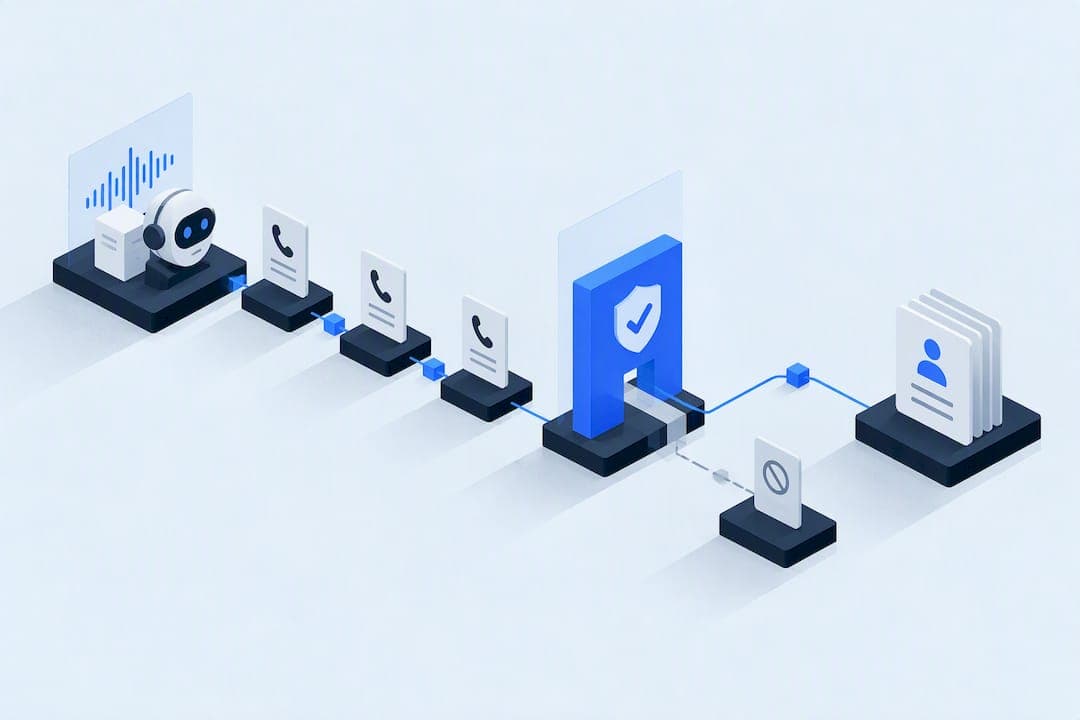
The call lifecycle has a predictable shape, which makes it easier to evaluate a platform or a custom build against. A list loads into the dialer, the system places calls in sequence or in parallel, and each connection runs through reach detection before the conversation engine takes over. A completed call writes its outcome, transcript, and next action back to the CRM, feeding a dashboard that tracks volume and results.
Before committing to a platform or a build, require these capabilities:
- Voicemail and answering machine detection (AMD): so the system doesn't waste a script on a mailbox.
- Branded or local caller ID: to improve pickup rates.
- Hot transfer: a live, in-call handoff to a human when the conversation calls for it.
- High concurrency: the ability to run many calls at once without degrading quality.
- Retry logic: smart rescheduling of no-answers rather than blind redials.
- Automated DNC scrubbing: checked before every batch goes out.
- Transcripts and call recordings: for QA and dispute resolution.
Platforms built for this kind of volume bake compliance and reporting into the dialer itself. Amazon Connect's outbound campaigns include voicemail detection, quiet-time controls, and do-not-call integration alongside dashboards for tracking performance, which is a reasonable baseline for what any serious outbound system should offer. Integration points matter just as much as the dialing engine: a CRM connection, calendar sync, a clear human-in-the-loop escalation path, and an analytics layer that shows results in near real time.
U.S. regulatory essentials for AI calling
Compliance isn't a side issue here, it's the difference between a working campaign and a legal liability. The FCC clarified that calls using an artificial or prerecorded voice fall under TCPA restrictions and require prior express consent for telemarketing purposes, which settles any argument that AI-generated speech sits outside the law.

A more recent change raises the bar further. The FCC adopted a one-to-one consent rule that closes the "lead generator" loophole, requiring each seller to obtain separate prior express written consent for robocalls using artificial or prerecorded voices. The rule, set out in the FCC's Second Report and Order, took effect January 27, 2025, which means a single consent checkbox covering multiple sellers no longer satisfies the requirement.
Practical safeguards to build into any campaign:
- Capture express written consent per seller, not as a blanket opt-in.
- Scrub every list against the national and internal DNC registries before dialing.
- Process consent revocation requests immediately and permanently.
- Restrict calling to permitted time windows based on the recipient's local time zone.
Implementation checklist for piloting and scaling AI outbound calling
A rollout works best as a staged process rather than a full launch on day one.
- Define goals and success metrics before writing a single script: contact rate, qualification rate, and transfer rate are a reasonable starting set.
- Verify consent and scrub the list against DNC registries before any calls go out.
- Run a small pilot, often a few hundred contacts, comparing script variants and measuring human-in-the-loop intervention rates.
- Audit conversation transcripts weekly during the pilot to catch awkward phrasing, compliance gaps, or missed intents.
- Set escalation thresholds, so calls that confuse the agent route to a live rep instead of looping.
- Scale gradually, watching dashboards for contact rate drift and adjusting retry cadence as volume grows.
- Lock down access, applying least-privilege controls to whoever can edit scripts, lists, or consent records.
Pro Tip: Treat the first pilot as a QA exercise, not a results exercise. Fixing conversation gaps early saves far more time than chasing volume from day one.
Equinox Strategies' security-first approach to AI outbound calling
A vendor committed to security and integration builds tailored lead generation systems, AI voice agents, and custom software for US service businesses, with every project scoped and documented before work begins. That documentation includes a written data map, explicit consent flows, and a rollback plan, delivered under a single accountable technical lead rather than handed off between departments.
When evaluating any vendor or integrator for AI outbound calling, ask for the same standard:
- A scoped, written project plan before any code or calls go live.
- A documented rollback plan in case a campaign needs to be paused or reversed.
- One accountable technical lead, not a rotating support queue.
- Documented, auditable consent flows tied to each contact record.
Why most AI outbound calling projects underperform early on
The projects that stumble usually skip consent verification, rush QA, or expect enterprise-scale results from a list of a few hundred names. A realistic first 90 days looks like a tight pilot, a round of transcript review, then a controlled scale-up, not a full campaign launch on week one. Watch contact rate, qualification rate, and transfer rate weekly. If those three numbers hold steady as volume grows, the system is working.
— Felix
How Equinox Strategies can help you roll out AI outbound calling
A provider builds AI voice agents, done-for-you automations, and integrated lead generation systems for US service businesses that need outbound calling to actually work, not just run. Every build is scoped and documented, with security controls and a dedicated technical lead behind it rather than a support ticket queue.

If you're weighing a pilot, start with an audit of your current lead response process, a defined pilot scope, and a security review of how consent and call data will be handled. Visit Equinox Strategies to scope a rollout built around your call volume and compliance needs.
FAQ
Is outbound calling with AI illegal?
AI outbound calling itself isn't illegal, but it falls under the same TCPA rules that govern any artificial or prerecorded voice call, which the FCC has confirmed applies to AI-generated voices. That means prior express consent, DNC scrubbing, and adherence to calling time windows are required, not optional.
What are the best AI outbound calling agents?
There's no single best platform, since the right choice depends on call volume, CRM integration needs, and compliance requirements specific to your business. Look for native voicemail detection, hot transfer, DNC scrubbing, and transparent documentation of how consent and data are handled before choosing a provider.
What is an AI outbound calling bot?
An AI outbound calling bot is a voice agent that initiates calls and carries on a dynamic, two-way conversation rather than playing a fixed recorded script. It uses speech recognition and language understanding to interpret what the caller says and respond in real time, then logs the outcome automatically.
What does "AI outbound" mean?
"AI outbound" refers to outbound business calls initiated and conducted by an AI voice agent instead of a human dialer or a static recorded message. It typically covers tasks like lead qualification, reminders, and surveys, handled at a scale manual calling can't match.
Sources
Direct FCC orders on AI voices and consent, plus Amazon Connect's outbound campaign documentation.