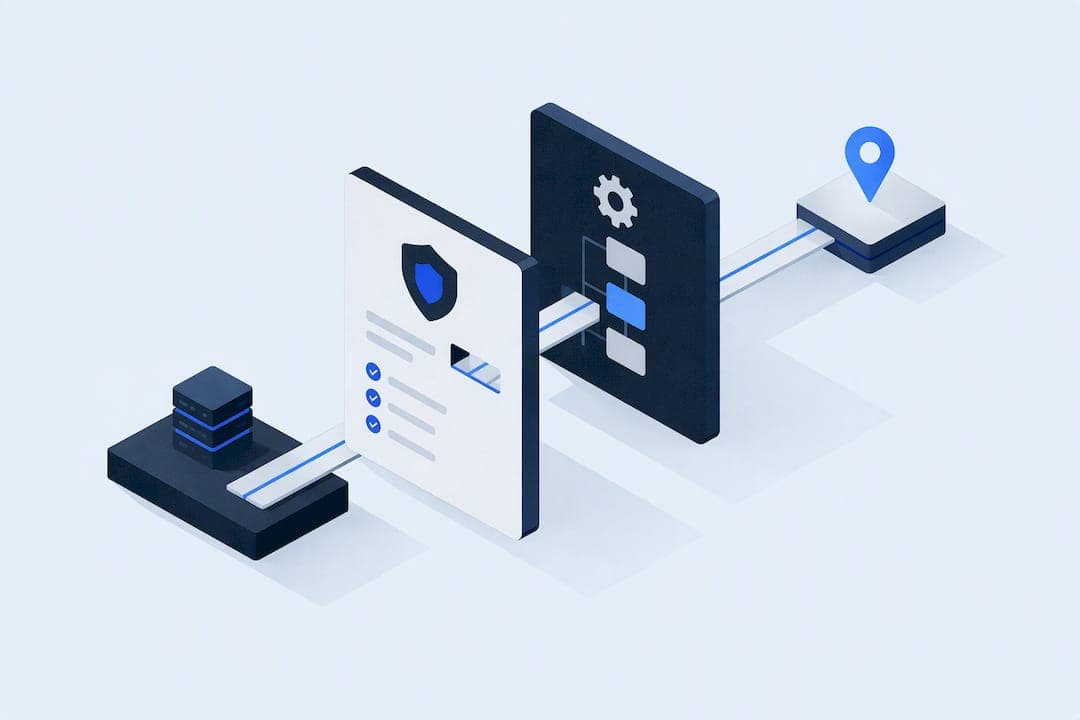
An automation runbook is a documented, security-scoped playbook for customer-facing workflows like lead intake, booking, and follow-up. It defines triggers, data flows, decision rules, manual handoffs, rollback steps, and monitoring, and it belongs in your operations binder, not buried in a developer's codebase. A scoped runbook is what prevents missed leads and limits compliance risk, and this guide covers its components, how to write one, security controls, contact rules, and how to keep it current.
TL;DR:
- A comprehensive runbook must include clear triggers, a detailed data map, explicit decision rules, manual handoff procedures, rollback templates, and monitoring protocols.
- Building the runbook involves mapping systems, assigning access roles, creating decision trees, and establishing acceptance tests, with emphasis on ease of understanding for non-developers.
- Security measures require applying least-privilege principles to automate permissions, documenting data retention points, and designating an incident lead for rollback execution.
- Contact compliance demands recording explicit consent, attaching it to leads, and promptly processing opt-outs, with adherence to FCC and FTC guidelines.
- Regular testing, monitoring for API changes, scheduled reviews, and immediate updates after incidents are vital to maintaining an effective, up-to-date runbook.
Table of Contents
- 1. What core components every runbook must include
- 2. A step-by-step checklist for writing your first runbook
- 3. Security and least-privilege controls to build in
- 4. Consent, recordkeeping, and revocation rules for contacting leads
- 5. Testing, monitoring and keeping the runbook current
- 6. How Equinox Strategies scopes and documents runbooks
- 7. Consider a scoped engagement to close your own gaps
- 8. Where to read the primary sources
- Sources
- FAQ
1. What core components every runbook must include
A runbook without these pieces is a wish list, not an operational document. Each component answers a specific question an employee or an auditor will eventually ask when something breaks.
- Triggers and entry points: name every source that can start the workflow, such as a web form submission, an inbound phone lead, or a purchased lead feed, and what each one hands off.
- A full data map: list every field captured, plus where it lands afterward, including logs, caches, and backups, and how long each copy is kept.
- Decision rules: qualification criteria written as testable statements ("if budget is under $5,000, route to voicemail queue") rather than vague judgment calls.
- Manual handoffs: who picks up the lead when automation stops, when that happens, and the exact escalation path.
- Rollback templates: a predefined undo step for each stage of the automation, plus who is authorized to execute it.
- Monitoring and audit logging: the channels that alert someone when a step fails, and the log that proves what happened afterward.
Skipping the data map is the most common gap. Teams document the primary database field but forget the backup snapshot or the analytics cache that also holds a customer's phone number, which becomes a problem the moment someone requests deletion.
2. A step-by-step checklist for writing your first runbook
Building a runbook is a sequence, not a single sitting. Work through it in order and resist skipping the access matrix because it feels like busywork.
- Scope the result: write the specific business outcome you want, such as "every inbound call gets a callback within 5 minutes," and list edge cases like after-hours calls or duplicate leads.
- Map every system: list each platform involved (CRM, calendar, phone system, spreadsheet) and where each field is written or cached.
- Build a role and access matrix: assign least-privilege permissions to every human and automated actor, so a booking bot can write to a calendar but never delete a customer record.
- Draw the decision tree: include explicit failure and rollback branches, not just the happy path.
- Write acceptance tests: define what "working" looks like before you deploy, then move through staging, a canary group, and full production.
- Log version history: record who approved each change and when, so the runbook itself has an audit trail.
Pro Tip: Keep the runbook in a shared document your front-office team can read without a developer present. If they cannot understand step 3, no one will follow it during an incident.
3. Security and least-privilege controls to build in
A runbook is also a security document, whether or not the business treats it that way. NIST SP 800-171r3 frames least-privilege access as a business process requirement, meaning it belongs in the runbook itself, not just in an IT policy binder.
- Grant automated agents only the write permissions their task requires, never broad account access "to keep things simple."
- Document shared-responsibility boundaries with any provider, including who has contractual authority to disable a service in an emergency.
- Map every data retention point, including logs and backups, so a privacy or deletion request can actually be honored in full.
- Name an incident lead with explicit authority to trigger rollbacks, and give that person a direct line into the runbook's rollback templates.
Documented incident playbooks improve response consistency during security events, according to NIST SP 800-61r3, which recommends testing or exercising these playbooks periodically rather than writing them once and filing them away. A runbook that has never been rehearsed tends to fail exactly when it matters most.
4. Consent, recordkeeping, and revocation rules for contacting leads
Contact compliance is not optional once automation starts texting or calling leads on your behalf. The FCC's Second Report and Order requires one-to-one prior express written consent for robocalls and robotexts in many contexts, closing the loophole where a single consent click authorized outreach from dozens of unrelated sellers. Messages must also be logically and topically associated with the interaction that produced the consent.
Separately, the FTC's Telemarketing Sales Rule guidance requires prompt, clear oral disclosures on outbound sales calls and sets recordkeeping obligations telemarketers must meet.
Build these into the runbook directly:
- Capture consent source, the exact disclosure shown, a timestamp, and the opt-in method with every lead record.
- Attach the consent record to the lead itself, not to a separate marketing list that can drift out of sync.
- Process opt-outs within a reasonable timeframe and log the revocation the same way you logged the original consent.
5. Testing, monitoring and keeping the runbook current
A runbook goes stale the moment a vendor changes an API or a form field gets renamed, so treat it as a living process rather than a document you write once.
- Pre-deployment: write test cases for the decision rules, roll changes out in stages, and define acceptance criteria before anything touches live leads.
- Production monitoring: set failure rate thresholds, watch for schema changes in connected systems, and reconcile downstream records regularly to catch silent drift.
- Scheduled reviews: revisit the runbook on a fixed cadence and whenever a vendor update, API change, or incident forces a change outside that schedule.
- Post-incident updates: fold lessons learned back into the document immediately, while the failure is still fresh, instead of waiting for the next scheduled review.
Platforms like Opsphere's operational intelligence tooling illustrate how live monitoring and observability patterns apply to automation that runs continuously rather than on a fixed schedule. The same logic applies whether the automation is answering phones or scheduling technicians, as shown in field-service examples like MyBizApps' scheduling guidance.
6. How Equinox Strategies scopes and documents runbooks
Most clients arrive with the same two problems: leads slip through cracks between systems, and nobody can explain why an automation did what it did last Tuesday. Equinox Strategies LLC addresses both by scoping every project before writing a line of automation, producing a written data map and a role-based access matrix as deliverables, not afterthoughts.

Each engagement has a single accountable technical lead, which helps keep the runbook consistent as it evolves. Least-privilege access is a starting assumption, not a later cleanup step: an AI voice agent gets exactly the calendar and CRM permissions its task requires, nothing broader.
The result is a runbook a front-office manager can actually audit: what triggers it, what it touches, and how to roll it back if something goes wrong.
— Felix
7. Consider a scoped engagement to close your own gaps

If missed leads or fragmented follow-up sound familiar, Equinox Strategies builds the fix as a scoped, documented engagement rather than a bolt-on tool. Services include done-for-you automations, AI voice and messaging agents, lead generation integrations, and ongoing operations support once the system is live. A discovery conversation covers scope, deliverables, documentation, and the single accountable lead who will own the build.
Visit the Equinox Strategies site to start that conversation and see whether a scoped automation runbook fits your workflow.

8. Where to read the primary sources
The security and compliance points above come from public guidance you can read directly: NIST's incident handling guide and least-privilege controls, the FCC's consent rules, FTC telemarketing guidance, and Harvard Business Review's lead-response research.
Sources
- NIST SP 800-171r3
- Federal Register: Targeting and Eliminating Unlawful Text Messages (FCC Second Report and Order)
- Complying with the Telemarketing Sales Rule | Federal Trade Commission
- Harvard Business Review: The short life of online sales leads
FAQ
What is the difference between a runbook and a playbook?
In practice, the terms overlap for customer-facing automation: both describe a documented procedure for handling a workflow, including triggers, decisions, and escalation steps. Some teams reserve "playbook" for the qualification and messaging strategy and "runbook" for the operational steps, but there is no universal split.
What should an audit trail record for lead automation?
An audit trail should record the trigger that started the workflow, every system that received or changed a piece of data, and any manual handoff or rollback that occurred. This matters for troubleshooting and for demonstrating compliance, since NIST SP 800-61r3 recommends documented, testable procedures for exactly this kind of review.
How fast should a business respond to a new lead?
Speed matters more than most businesses assume: Harvard Business Review's research found that many companies respond to online leads too slowly and lose conversions as a result. Building a fast, automated first response with a clear manual handoff path is one of the more reliable ways to close that gap.
Do I need written consent before texting a lead?
In many cases, yes. The FCC's Second Report and Order requires one-to-one prior express written consent for robocalls and robotexts, and any message must be topically tied to the interaction where that consent was given.
Does Equinox Strategies build these runbooks for clients?
Yes, Equinox Strategies LLC scopes and documents automation runbooks as part of its done-for-you automation and AI voice agent engagements, including written data maps and least-privilege access design. Pricing depends on project scope and is available on request through the company's site.