Caller identity verification, in the sense that matters for your front office, is a workflow check built into your inbound-call process that matches a caller to a record, confirms who they are, and captures consent before your team or an AI voice agent moves forward. If you run a service business, the first move is simple: scope a verification flow for your highest-risk call types and build consent capture into it from day one.
TL;DR:
- Match callers against CRM records using two signals when possible, then use one confirmation question with an SMS code as the fallback.
- AI generated voices used to initiate calls generally require prior express consent, caller identification, disclosures, and an opt out method for telemarketing calls.
- Route failed checks to a human, and require human review for payment changes, personal information updates, and contract terms before approval.
- Log every attempt with its method and timestamp, restrict access to necessary staff, and review monthly failure patterns for possible social engineering.
Table of Contents
- What caller identity verification means here: scope and exclusions
- How to design and deploy a verification workflow for inbound calls
- Compliance and consent: how TCPA and the FCC's AI/voice guidance affect verification flows
- Security, privacy, and integration checklist
- Practical templates: scripts and verification flow patterns to copy
- When to automate verification and when to escalate to a human
- Equinox's approach: security-led scoping and accountable implementation
- How Equinox can help implement secure caller identity verification
- FAQ
- Sources
What caller identity verification means here: scope and exclusions
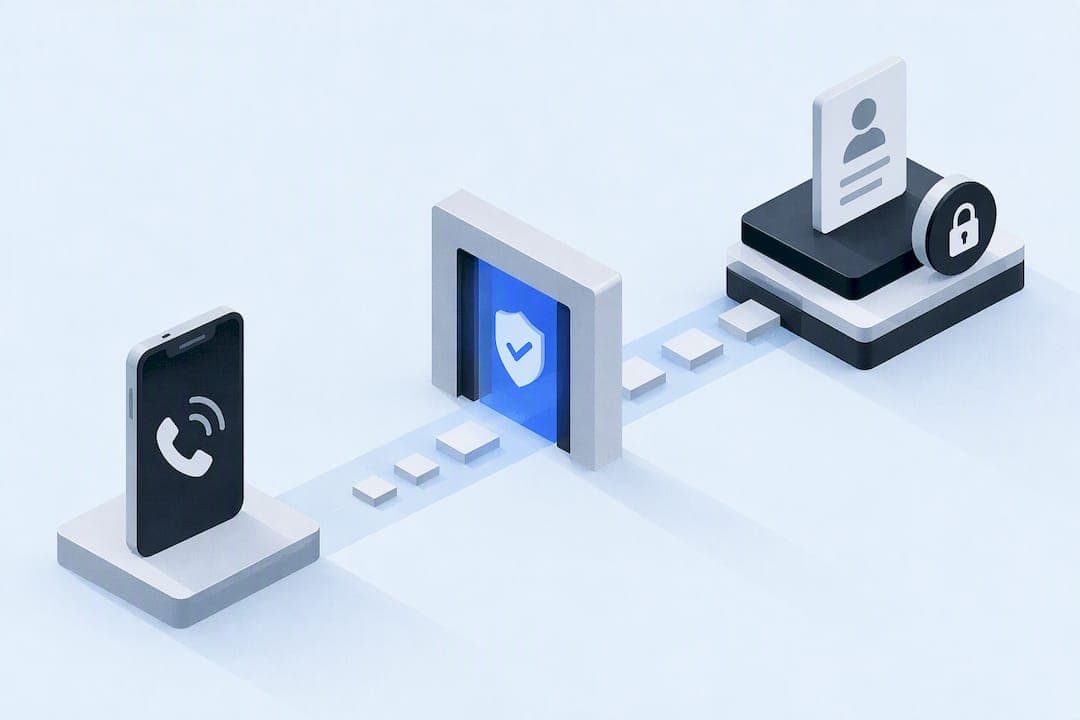
In this guide, caller identity verification is application-level: it happens inside your business workflow, not on the telephone network. A typical check matches an incoming number against a CRM record, asks a confirmation question ("Can you confirm the service address on file?"), or sends a one-time code to verify a lead before booking or quoting. This is distinct from carrier-level caller ID authentication, the network protocols designed to stop number spoofing at the telecom layer. That technology addresses whether a call's displayed number is genuine; it says nothing about whether the person on the line is who they claim to be in your system.
The distinction matters because the tools differ completely. A carrier-level fix lives with your phone provider. A workflow-level fix lives in your CRM, your AI voice agent, and your automation logic, and it is the layer you actually control when deciding who gets a quote, a refund, or access to an account.

How to design and deploy a verification workflow for inbound calls
Building a reliable verification workflow takes five stages, each with its own decisions.
- Scope the trigger points. Decide which call types require verification (new leads, account changes, payment requests) and define what a pass or fail outcome looks like, including where that status gets flagged in your CRM.
- Pick your data sources. Match incoming calls against CRM fields like phone number, name, appointment ID, or a lead token sent in a prior text message. Combining two weak signals (name plus phone number) usually beats relying on one.
- Choose your verification technique. Common options include a confirmation question, an SMS one-time passcode (OTP), a knowledge check against account details, or a reference number from a previous interaction.
- Log everything and set handoff rules. Every verification attempt, pass or fail, should write to the CRM record with a timestamp and method used. Failed attempts should trigger a defined handoff to a human agent rather than a dead end.
- Test before launch. Run the flow in staging with sample calls that mimic real scenarios, including intentionally mismatched data, then monitor live call outcomes for the first two to four weeks.
Matching strategy depends on what your business already tracks. A plumbing company with appointment-based scheduling can verify against appointment IDs; a subscription-based service might prefer an OTP sent to the number on file.
Pro Tip: Start with one confirmation question and an OTP fallback. Adding more verification steps than that tends to increase call abandonment without meaningfully improving match accuracy.
Compliance and consent: how TCPA and the FCC's AI/voice guidance affect verification flows
If your verification flow uses an AI-generated or prerecorded voice, federal rules apply. The FCC's 2024 Declaratory Ruling clarified that AI-generated voices qualify as an "artificial or prerecorded voice" under the TCPA, which means calls using that technology generally require prior express consent and must include caller identification and required disclosures. Legal analysis from Wilson Sonsini confirms that businesses using AI voices should secure that consent absent an applicable exemption and build in opt-out methods where the call qualifies as telemarketing.
AI-generated voices used to initiate calls are now treated as artificial or prerecorded voice under the TCPA, a classification that applies regardless of how natural the voice sounds, according to the FCC's ruling.
Practical steps to stay on the right side of this:
- Identify the caller and the business at the start of any call using an artificial voice.
- Confirm whether the call falls under prior express consent requirements or an existing exemption before you deploy it.
- Include a clear opt-out method if the call has any telemarketing purpose.
- Keep a timestamped record of when and how consent was obtained for each caller.
Goodwin's analysis of the ruling notes that the specific disclosure and consent obligations still depend on the substance of the call, so an informational verification call and a sales call are not treated identically.
Security, privacy, and integration checklist
A verification workflow handles sensitive data: phone numbers, account details, sometimes payment information. Treat it with the same discipline as any other access control system.
- Write a data map before building anything: what gets collected, where it is stored, who can see it.
- Apply least-privilege access so only the roles that need verification data can query it.
- Encrypt stored tokens and call recordings, and set a retention window instead of keeping them indefinitely.
- Store proof of consent (timestamp, method, recording reference) separately from operational data so it survives a system migration.
- Build a rollback plan so a bad deployment can be reverted without losing verification history.
- Log every access to verification records for troubleshooting and audit purposes.
- Monitor for repeated failed attempts from the same number, a common sign of a social engineering attempt rather than a genuine mismatch.
Pro Tip: Review your verification failure logs monthly. A sudden spike in failures from one area code often signals a targeted spoofing attempt rather than a data entry problem on your end.
Practical templates: scripts and verification flow patterns to copy
These patterns work for most inbound service calls and are easy to adapt.
- Opening verification script: "Before we go further, can you confirm the name and service address on your account?" If it matches, proceed. If not, move to OTP.
- SMS OTP flow: Send a six-digit code with a five-minute expiry window immediately after the call connects. Ask the caller to read it back before continuing.
- Failed verification handoff: "I'm not able to confirm those details right now. Let me connect you with someone on our team who can help." Log the call ID, reason for failure, and timestamp in the CRM.
- Friction reduction: Keep it to one confirmation question plus an OTP fallback. Stacking three or more checks before a human engages tends to push callers to hang up.
When to automate verification and when to escalate to a human
Automate verification for routine checks: booking confirmations, appointment reschedules, general inquiries. Escalate to a human whenever a call touches payment changes, personal information updates, or contract terms, since the cost of a mistaken automated approval is far higher than the time saved.

Track a few core metrics: verification success rate, average time to verify, handoff rate to humans, and false positive rate (legitimate callers wrongly flagged). A rising handoff rate alongside a falling success rate usually means your matching logic needs tightening, not more verification steps.
Equinox's approach: security-led scoping and accountable implementation
Every verification build should include a written data map, explicit consent flows, least-privilege access, and a rollback plan, all overseen by a single accountable technical lead rather than passed between teams. When we integrate verification into an AI voice agent, it writes directly to your CRM and reporting, so a failed check shows up where your team already looks.
— Felix
How Equinox can help implement secure caller identity verification
If building this in-house feels like more than your team has time for, we design and deploy caller identity verification as part of our AI voice and messaging agents and done-for-you automations, integrated directly with your existing CRM rather than bolted on as a separate tool.

A scoping call with us covers:
- A written security checklist for your specific call types and risk points.
- A documented data map showing exactly what gets collected and where it lives.
- A proof-of-concept plan before any full build begins.
For businesses already using a hosted phone system, some providers work alongside partners like 3CX through NEXTmsp when call routing and verification need to work together. If you want a verification flow that matches your actual workflow instead of a generic template, book a consultation with our team to start scoping it.
FAQ
What is the difference between application-level and carrier-level caller verification?
Application-level verification happens inside your business workflow, matching a caller to CRM records or confirming details before your team proceeds. Carrier-level caller ID authentication is a separate telecom-network function focused on preventing number spoofing, and it is not covered in this guide.
Do I need caller consent if my AI voice agent only verifies identity?
It depends on the substance of the call. The FCC's ruling treats AI-generated voices as artificial or prerecorded voice under the TCPA, so if the call initiates contact rather than responding to an inbound request, prior express consent and disclosure requirements generally apply.
What should happen when a caller fails verification?
The call should hand off to a trained human agent rather than proceeding, with the reason for failure and timestamp logged in the CRM. Repeated failures from the same number are worth flagging for review rather than retrying immediately.
Which metrics show whether a verification flow is working?
Track verification success rate, average time to verify, how often calls get handed off to a human, and the false positive rate for legitimate callers. A pattern of rising handoffs alongside falling success rates usually points to a matching logic problem.
How much friction should a verification step add to a call?
Most flows work well with a single confirmation question and an OTP fallback, since adding more steps tends to increase abandonment without improving accuracy. Keeping the flow to one or two checks, logged automatically, balances security with a smooth caller experience.