
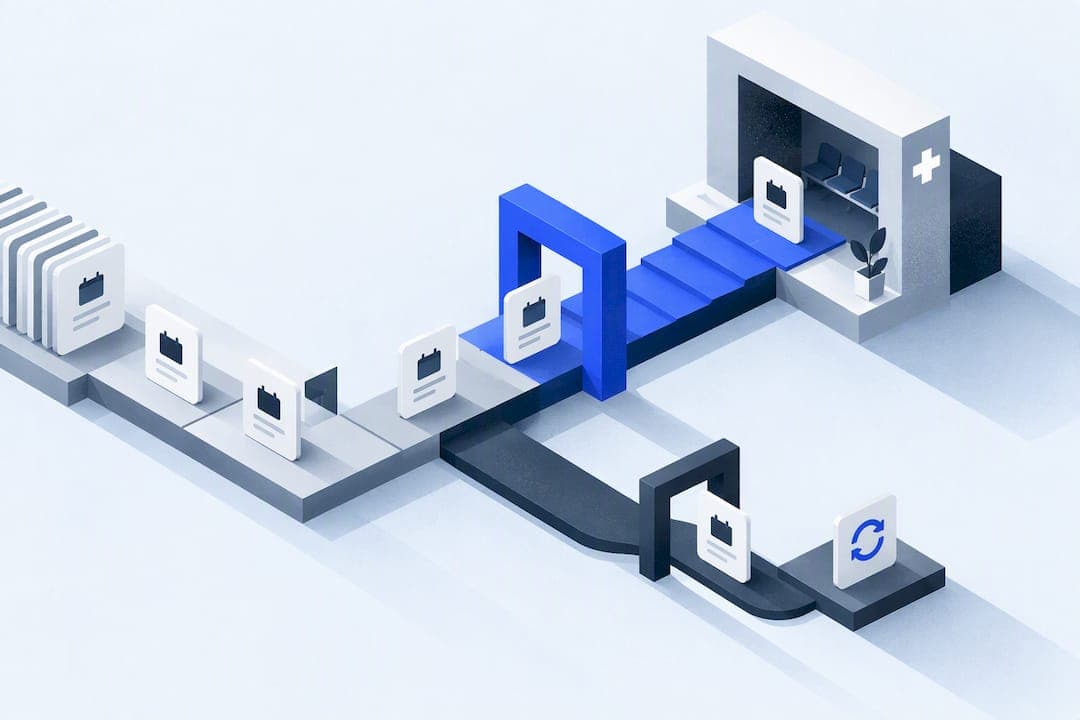
Stack automated, well-timed multi-channel reminders with targeted live outreach for high-risk patients and a few scheduling fixes, and most clinics can meaningfully cut no-shows within weeks. A 2025 meta-analysis found reminders raise attendance by 11% on average, and that effect compounds when paired with shorter lead times and self-scheduling. Start with a quick data pull to find your current no-show rate and its top drivers before changing anything.
TL;DR:
- Reminders paired with shorter lead times and self-scheduling can increase attendance by up to 11%, but effectiveness varies by appointment type and patient cohort.
- Conducting a data audit helps identify whether timing, access issues, or specific patient groups drive no-shows before implementing fixes.
- Automating two-way reminders with reschedule links and targeted live outreach for high-risk patients is more effective than solely relying on policy changes or fees.
- Shorter lead times, same-day slots, and telehealth options can reduce no-shows but should be tailored to visit type and patient needs to avoid overbooking risks.
- Clinics should track specific KPIs like no-show rate, confirmation rate, and fill rate over a pilot period before scaling no-show reduction strategies.
Table of Contents
- Prioritized tactics clinics can implement now
- Diagnose first: audit your no-shows before picking fixes
- Reminders and communications: evidence, setup, and HIPAA guardrails
- Scheduling and access changes that lower no-show risk
- Policy and fees: a cautious, practical approach
- Targeted outreach for high-risk patients and equity safeguards
- Measurement and KPIs that prove progress
- 30-60-90 day implementation checklist
- What a secure automation build looks like in practice
- What typically works and where clinics go wrong
- Where Our company fits into your no-show reduction plan
- FAQ
- Sources
Prioritized tactics clinics can implement now
Before adding new software or policies, rank the fixes by effort versus payoff. Reminders and self-scheduling cost little and pay off fast. Policy changes and staffing shifts take longer but hold gains once reminders plateau.
- Automated multi-channel reminders: send a text or email 48 to 72 hours out and a second reminder 24 hours before, each with a one-tap confirm or reschedule link.
- Self-scheduling and rescheduling: let patients pick and move their own slots online, with a mobile-first form that asks for only name, date of birth, and reason for visit.
- Waitlist and same-day fills: automate a text blast to waitlisted patients the moment a slot opens, so a cancellation becomes a filled appointment instead of an empty one.
- Shorter lead times and telehealth: offer same-day or next-day slots for routine visits and a telehealth swap option for patients who are more likely to skip an in-person trip.
- Clear no-show policy and scripts: state the policy at booking and reinforce it verbally for repeat no-show patients, without sounding punitive.
- Operational scheduling tactics: use controlled double-booking for appointment types with chronic no-show history, and build schedules in a "Tetris" style that groups short visits together to absorb gaps.
Message content matters as much as timing. A reminder that only states date and time performs worse than one that also names the provider, the visit reason, and a direct link to confirm, cancel, or reschedule in one tap. Clinics that skip the reschedule link lose a share of patients who would have moved the appointment rather than skipping it outright.
Double-booking deserves a caution: it works for chronic no-show slots at a group level, but applying it broadly risks overbooking patients who do show, creating long waits and worse experience scores. Reserve it for specific appointment types and providers where your data shows a persistent pattern.
Pro Tip: Add the reschedule link to every reminder message, not just the first one. Patients who ignore a 72-hour reminder often act on a 24-hour one if given a one-tap option to move instead of cancel.
Diagnose first: audit your no-shows before picking fixes
Running tactics without a diagnosis wastes staff time on the wrong problem. A short audit tells you whether your issue is timing, access, or a specific cohort, and operational guidance on rollout velocity supports starting here before anything else.
- Pull a no-show report from your EHR or practice management system for the last 90 days, including appointment type, provider, lead time, and patient history.
- Segment the results by appointment type first: new patient visits, follow-ups, and procedures often have very different no-show patterns.
- Slice by lead time next: appointments booked more than four weeks out typically show higher no-show rates than same-week bookings.
- Flag patients with two or more no-shows in the past year as your high-risk cohort for targeted outreach.
- Pick one cohort, a four to eight week window, and one primary metric (no-show rate for that cohort) to run a focused pilot before scaling anything clinic-wide.
This diagnostic phase takes a staff member a day or two, and it prevents months of effort on tactics that do not match your actual drivers.
Reminders and communications: evidence, setup, and HIPAA guardrails
**A 2025 systematic review and meta-analysis found reminders increase attendance by 11% on average (RR = 1.11, 95% CI: 1.05 to 1.19) compared to usual care. Earlier reviews reporting pooled no-show rates drop from 21% in control groups to 15% with reminders in place. That is a meaningful but not total fix: reminders move the needle, they do not eliminate the problem alone.
A practical cadence is two touches: one message 48 to 72 hours before the visit and a second 24 hours out, using text as the primary channel and email or a phone call as backup for patients who do not respond. Reserve a live phone call for high-risk patients identified in your diagnostic audit, since calls cost more staff time but tend to work better for patients who have already missed reminders once.
- Treat appointment reminders as treatment communications under HIPAA guidance from HHS, which do not require separate authorization under 45 CFR 164.506.
- Apply the minimum necessary standard under 45 CFR 164.502(b): include only what the patient needs to confirm or reschedule, never diagnosis or treatment detail.
- Get consent before texting and provide a clear opt-out, since standard SMS is not encrypted and should never carry protected health information.
- Build two-way confirmation into every reminder so a single reply or tap can confirm, cancel, or trigger a reschedule flow without a phone call.
Scheduling and access changes that lower no-show risk
Shorter lead times reduce the window in which life gets in the way of an appointment, and clinics that open more same-day or next-day slots for routine visits see fewer of them convert to no-shows. Telehealth works well as a backstop for patients with transportation or time barriers, though it is not a universal fix: visits requiring physical exams or in-person testing still need to stay in person.
- Open a defined block of same-day slots each day and fill them first from your waitlist before offering them to new bookings.
- Automate waitlist texts the moment a cancellation happens, so the first patient to reply gets the slot.
- Offer a telehealth swap option at the time of reminder for visit types that do not require a physical exam.
- Configure self-scheduling so patients can reschedule within a defined window (for example, up to 24 hours before) without calling the front desk.
The goal is to remove friction at every point a patient might otherwise just skip the call to cancel. A patient who can reschedule in two taps is far more likely to do that than to simply not show up.
Policy and fees: a cautious, practical approach
A written no-show policy helps set expectations, but it only works when communicated clearly and applied consistently. State the policy at the time of booking, repeat it in the first reminder, and use a calm, factual script rather than a threatening tone when speaking with repeat no-show patients.
- Write the policy in plain language: how many no-shows trigger a fee or a conversation, and what counts as sufficient notice to cancel.
- Verify state and payer rules before charging any fee, since Medicaid and some other payer contracts restrict or prohibit no-show charges.
- Offer a grace call before a first fee, explaining the policy and asking what would help the patient keep the next appointment.
- Use non-fee alternatives, like priority booking for reliable patients or targeted outreach for at-risk ones, to protect access without penalizing patients who face real barriers.
Fees can discourage no-shows for some patients, but they can also drive vulnerable patients away from care entirely. Treat them as a last resort, not a first lever.
Targeted outreach for high-risk patients and equity safeguards
Once your audit flags a high-risk cohort, a randomized quality improvement trial found that adding risk-model-driven telephone outreach to standard reminders reduced composite no-show rates from 36.2% to 32.8% (p<0.01), with a notably stronger effect for Black patients, narrowing a disparity in attendance. The outreach in that trial focused calls on patients with a predicted no-show risk of 15% or higher, rather than calling everyone.

Operationalize this by flagging patients with multiple recent no-shows, long appointment lead times, or known access barriers like unreliable transportation, and routing only those patients to a live call instead of a text. Any risk model used this way needs a human check: review flagged lists periodically to confirm the model is not disproportionately targeting any group in a way that reduces their access rather than supporting it.
Non-digital supports matter just as much as the outreach itself: transportation assistance, interpreter availability, and flexible scheduling hours address barriers reminders cannot fix on their own.
Pro Tip: When a live call is warranted, offer a concrete next step, like rebooking to a closer date, switching to telehealth, or connecting the patient with transportation help, rather than just confirming the existing time.
Measurement and KPIs that prove progress
Track no-show rate (no-shows divided by total scheduled appointments), confirmation rate (confirmed divided by reminders sent), fill rate (filled cancellations divided by total cancellations), and revenue per slot to see whether your changes are working.
| Metric | Formula | What it tells you |
|---|---|---|
| No-show rate | No-shows / total scheduled appointments | Overall attendance health |
| Confirmation rate | Confirmed responses / reminders sent | Reminder engagement |
| Fill rate | Filled cancellations / total cancellations | Waitlist and backfill effectiveness |
| Revenue per slot | Total revenue / total scheduled slots | Financial impact of no-shows |
Slice each metric by provider, appointment type, and time of day or week to spot patterns a single clinic-wide number hides. Run a simple before-and-after time-series comparison on your pilot cohort rather than a full statistical trial: four to eight weeks of data before and after a change is usually enough to see whether the intervention is working.
30-60-90 day implementation checklist
A phased rollout keeps the project manageable and gives you real data before committing to clinic-wide changes.
- Days 0 to 14: pull 90 days of no-show data, segment it, and select one pilot cohort and a primary metric to track.
- Days 14 to 42: launch automated reminders with the 48 to 72 hour and 24 hour cadence, add consent and opt-out language, and turn on reschedule links.
- Days 42 to 90: add waitlist automation and targeted live outreach for the high-risk cohort, and document the workflow as a standard operating procedure.
- Day 90 and beyond: review the pilot's results against your baseline, adjust cadence or scripts as needed, and roll the working combination out to additional providers or appointment types.
Assign one owner for each phase, usually a front office lead for scheduling changes and a clinical lead for outreach scripts, so accountability does not get lost between teams.
What a secure automation build looks like in practice
I've worked with service businesses building out automated outreach and scheduling systems, and the pattern that holds up is the same one clinics need: scope the project narrowly, document the data flow, and assign one accountable technical lead rather than scattering the build across tools that do not talk to each other. We follow that approach for every automation build: least-privilege access, written data maps, explicit consent flows, and a rollback plan before anything goes live. That discipline matters more in healthcare than almost anywhere else, since a reminder system that mishandles patient data creates liability no attendance gain can offset.

What typically works and where clinics go wrong
The biggest mistake I see is skipping the diagnostic step and buying a reminder tool because a vendor promised it would fix everything. Reminders help, but they are one piece: clinics that pull their own data first consistently get better, faster results because they know whether their problem is timing, access, or a specific patient cohort.
The second mistake is treating a new no-show policy as the primary lever instead of reminders and scheduling fixes. Policies and fees work best as a backstop, not a first move. Give the front office real ownership of scheduling changes, and give clinical staff ownership of outreach scripts: splitting both the same way tends to stall projects before they start.
— Felix
Where Our company fits into your no-show reduction plan
If you want these pieces built rather than pieced together, we design and build the reminder, waitlist, and outreach automations clinics and other service businesses need to cut no-shows without adding staff hours. 
Our work covers AI voice and messaging agents that handle reminder calls and confirmations, done-for-you automation builds for waitlist backfill and reschedule flows, and custom software when an off-the-shelf scheduling platform cannot handle a clinic's specific workflow. Every project starts with a scoped plan and a single accountable technical lead, so the data flows are clear and there is a point of contact for changes.
For a conversational example of what automated booking and waitlist management can look like in a service business, see how Vural handles WhatsApp-based scheduling and cancellations, a useful comparison point even though our builds are scoped individually rather than sold as a fixed platform.
If your clinic is ready to move past spreadsheets and manual callbacks, reach out through our services page to scope a project built around your actual no-show data.
FAQ
What is your process to reduce no shows?
Start with a short data audit to find your current no-show rate and its drivers, then stack automated multi-channel reminders with self-scheduling and waitlist automation, adding targeted live outreach for high-risk patients identified in the audit. Run this as a four to eight week pilot on one cohort before scaling clinic-wide.
How can I reduce the number of no-show appointments?
Combine automated reminders sent 48 to 72 hours and 24 hours before a visit with one-tap confirm and reschedule links, since a 2025 meta-analysis found this raises attendance by 11% on average. Add shorter lead times, same-day slots, and a live call for patients who have missed appointments before.
How to professionally say no show?
Use neutral, factual language like "missed appointment" or "unattended visit" rather than language that sounds punitive, both in your records and when speaking with the patient. Pair the conversation with a concrete next step, such as rebooking or asking what would help them keep the next visit.
What is the average no show rate for doctor appointments?
No-show rates vary widely by practice and appointment type, but research on reminder interventions found control group no-show rates around 21% without reminders, dropping to about 15% with reminders in place. Your own rate depends heavily on appointment type, lead time, and patient population, which is why a clinic-specific audit matters more than a national average.