
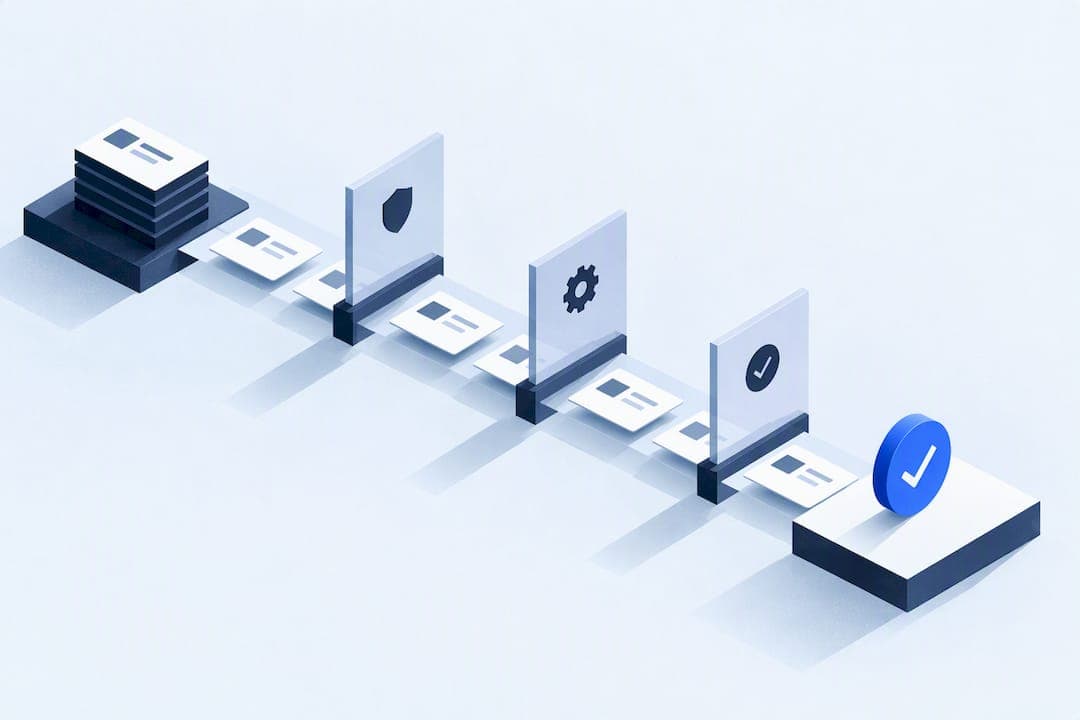
User acceptance testing confirms that a release candidate, deployed in a production-like environment, actually satisfies the business requirements it was built for, not just the technical specs. It runs after internal QA closes out, once the build is feature-complete, and it exercises real user journeys rather than code paths. Before you execute a single test, work through the entry checklist below so the effort you spend testing actually counts.
TL;DR:
- UAT should only begin once the build is feature-complete, defect-free, and environment parity with production is ensured.
- Clear roles and responsibilities, especially for deciding "done" and defect triage, are crucial to prevent delays and miscommunication.
- Test data must replicate real usage patterns with masking or synthetic data, and a smoke test should be run in UAT a day prior to testing.
- Structured defect reports with detailed steps and environment info accelerate fixes and regression testing, maintaining testing momentum.
- An objective sign-off process, with documented acceptance criteria, open risks, and rollback plans, reduces ambiguity and ensures readiness for launch.
Table of Contents
- Who participates in UAT and what each role must do
- UAT prerequisites and readiness checklist (entry criteria)
- Step-by-step UAT execution checklist
- Test case and scenario templates for faster UAT setup
- Entry and exit criteria: when to start and when to sign off
- Common UAT mistakes and best practices
- Sign-off, go-live readiness, and post-release review
- How a security-first, documented approach changes UAT outcomes
- Get help implementing a UAT process that actually holds up
- FAQ
- Sources
Who participates in UAT and what each role must do
UAT fails most often because nobody clarified who decides what "done" means. A workable UAT team has five roles, and each one owns a distinct part of the process.
The product owner holds the acceptance criteria and has final say on whether a defect blocks release. Business stakeholders and end users execute the test cases, since they represent the people who will actually use the software daily. QA leads or testers write and maintain the test scripts, track execution, and keep the defect log current. Developer support stays on call to fix blocking issues quickly and confirm fixes before retest. Operations staff step in when the release needs operational acceptance testing, covering things like backup procedures, deployment runbooks, and monitoring configuration.
A simple responsibility matrix keeps the run from stalling on ambiguity:
- The product owner approves acceptance criteria and signs off on release readiness.
- QA leads log every defect with reproduction steps and assign initial severity.
- A designated triage owner (often the product owner plus one developer) decides priority within an agreed time window.
- The product owner or a named business sponsor gives the final sign-off, not the testers who found the bugs.
Picking testers matters as much as picking the process. Choose people who actually do the job the software supports, not just anyone available that week. A claims adjuster testing a claims workflow will catch problems a generalist tester never will. Brief testers before day one: give them the scope, the acceptance criteria tied to their assigned scenarios, and a short walkthrough of the bug-reporting tool so the first hour isn't spent on tooling confusion instead of testing.
UAT prerequisites and readiness checklist (entry criteria)
Running UAT against a build that isn't ready wastes tester time and produces false confidence either way: testers either rubber-stamp a broken build because they don't know what to check, or they flood the defect log with issues that internal QA should have caught first. Practical UAT checklist guidance groups pre-testing work into readiness, environment and data readiness, and test-case readiness, all completed before execution starts.
Work through this sequence before you schedule a single tester:
- Confirm scope and objectives are documented and signed off by the product owner and business sponsor.
- Verify acceptance criteria are written for every in-scope feature and traced back to the user stories that generated them.
- Confirm the build is feature-complete and internal QA has closed its test cycle with no open blocker defects.
- Check environment parity: the UAT environment should mirror production configuration, integrations, and data volume as closely as practical.
- Load realistic test data that reflects actual usage patterns without exposing live customer records.
- Confirm every tester has working credentials and the correct access level for their assigned scenarios.
- Document a rollback plan and confirm monitoring and bug-reporting tools are configured and accessible.
- Confirm tester availability against the execution schedule, including backup coverage if someone drops out.
ISTQB's test management guidance stresses that acceptance criteria should be developed collaboratively by business analysts, product owners, and testers during requirements elicitation, not written after the fact by one person guessing at what stakeholders want. Criteria built this way give everyone a shared, testable definition of "acceptable," which is exactly what prevents arguments at sign-off time.
Test data deserves its own line item. Synthetic or masked data that mirrors real volume and edge cases, like unusual addresses, partial records, or boundary values, catches more problems than a handful of clean sample rows. Treating the environment as a first-class deliverable rather than an afterthought is one of the more reliable predictors of whether UAT catches real production defects.

Pro Tip: Run a 30-minute smoke test in the UAT environment the day before testers arrive. If login, navigation, and core data loads don't work, you'll find out before wasting a full team's first morning.
Step-by-step UAT execution checklist
Once entry criteria are met, the execution phase follows a repeatable sequence rather than an open-ended free-for-all. Structure keeps the team moving and keeps the defect log usable instead of chaotic.
Start every UAT cycle with tester onboarding and a smoke test. Walk testers through the environment, confirm their access works, and run a handful of critical-path checks (login, core navigation, one end-to-end transaction) before anyone starts formal scripts. This catches environment problems in minutes instead of after half a day of wasted scripted testing.
From there, move into scripted execution against acceptance criteria, balanced with dedicated exploratory time:
- Execute scripted test cases in priority order, starting with the highest-risk user journeys first.
- Map every test case to a specific acceptance criterion so a passed test has clear evidence behind it.
- Reserve a block of exploratory testing time, separate from scripted execution, specifically to surface edge cases scripts don't cover.
- Log every issue immediately using a standardized defect template rather than a running notes document.
- Triage new defects within an agreed window using severity categories (blocker, major, minor, cosmetic).
- Retest fixes as soon as they land and run regression on any flow the fix touched.
- Update the tracking sheet or dashboard daily so stakeholders can see real coverage, not just activity.
Practical UAT guides recommend mixing scripted test cases that map directly to acceptance criteria with scheduled exploratory sessions, since scripts alone tend to miss the unusual paths real users find within the first hour of actual use. A tester who's told "try to break the checkout flow for twenty minutes, no script" will often surface more valuable defects than another full day of scripted regression.
Defect triage is where most UAT cycles either stay on schedule or slip by a week. Severity categories need firm definitions before testing starts, not invented on the fly when the first bug appears. A blocker stops a core user journey entirely. A major defect degrades the journey but allows a workaround. A minor defect is cosmetic or affects a rarely used path. Agree on these definitions with the product owner during the entry checklist, not during triage itself, so disagreements about priority don't stall the whole run.
Structured defect reports speed everything downstream. Reports that include reproduction steps, expected versus actual results, environment details, and a session recording cut the back-and-forth between testers and developers that otherwise eats days out of a UAT schedule. A defect report that just says "checkout broken" forces a developer to reconstruct the bug from scratch; a report with five numbered steps and a screenshot gets fixed the same day.
Regression testing after a fix deserves the same rigor as the original test. Confirm the specific defect is resolved, then re-run the test cases for any feature that shares code, data, or workflow with the fix. Skipping this step is how a UAT cycle ships a fix for bug one and introduces bug two in the same release.
Track progress against the plan daily rather than waiting until the end of the cycle to discover you're behind. A simple spreadsheet with columns for test case ID, status, tester, and linked defect ID gives stakeholders a real-time view without requiring dedicated reporting software. A significant portion of software defects found late in a project often trace back to requirements that were unclear or incomplete at the start, which is why acceptance criteria quality during the entry checklist matters more than the volume of test cases you run during execution.
By the time execution wraps, you should have a clean picture: every scripted case executed with a pass or fail status, every open defect triaged and assigned, and exploratory findings logged with the same rigor as scripted ones.
Test case and scenario templates for faster UAT setup
A consistent test case format lets testers move fast and lets reviewers trust what they're reading without chasing down missing context. Use these fields for every test case, scripted or exploratory:
- Title: a short, specific description of what's being tested.
- Objective: the business goal the test confirms, tied to a user story.
- Preconditions: account state, data, or configuration required before starting.
- Steps: numbered actions a tester follows in order.
- Expected result: what should happen if the feature works correctly.
- Actual result: what happened, filled in during execution.
- Data used: the specific inputs, so a failure can be reproduced exactly.
- Trace to acceptance criteria: the specific criterion this test case validates.
Three short examples show how this template adapts across different scenario types:
| Scenario type | Objective | Key step | Traces to |
|---|---|---|---|
| Core user journey | Confirm a returning customer can complete checkout | Add item, apply saved payment method, confirm order | Acceptance criterion: checkout completes in under 3 steps for returning customers |
| Negative path | Confirm the system rejects an expired payment card | Submit checkout with a card flagged as expired in test data | Acceptance criterion: expired cards are rejected with a clear error message |
| Integration scenario | Confirm a new visitor record syncs to the CRM after sign-in | Submit a visitor sign-in form, check CRM for matching record promptly | Acceptance criterion: visitor data syncs to CRM without manual entry |
That last integration example reflects a pattern common to UAT for any system with third-party dependencies: a workplace visitor management tool like EntryWatch's accounting firm solution has to prove sign-in data reaches downstream systems reliably before an accounting firm would trust it for compliance logging, which is exactly the kind of integration test case teams underestimate until UAT surfaces the gap.
Exploratory sessions still need documentation, just lighter than scripted cases. A short note covering what area was explored, what was tried, and what was found keeps the session useful to the rest of the team instead of living only in one tester's memory. When your source requirements are written as Given/When/Then statements, ISTQB references Gherkin as a common structure for acceptance tests in behavior-driven contexts, and translating that structure into test steps is mostly mechanical: "Given" becomes your precondition, "When" becomes your steps, and "Then" becomes your expected result.
Entry and exit criteria: when to start and when to sign off
Deciding when UAT starts and when it ends should never come down to a gut feeling or a looming deadline. Checklist-driven readiness and closure criteria give teams an objective basis for both decisions, which removes a surprising amount of politics from the sign-off conversation.
Entry criteria, confirmed before execution begins:
- The build is feature-complete with no planned scope changes mid-cycle.
- Internal QA has closed its cycle with zero open blocker defects.
- The UAT environment matches production configuration closely enough that results are trustworthy.
- Test data is loaded, realistic, and access-controlled.
- Testers are briefed, credentialed, and scheduled.
Exit criteria, confirmed before sign-off:
- All blocker and critical defects are resolved and retested, or formally accepted by the product owner with a documented reason.
- An agreed coverage threshold is met, for example all high-priority test cases executed and a defined percentage of medium-priority cases closed.
- Exploratory testing sessions are complete and findings triaged.
- The business sponsor or product owner has reviewed open risks and formally approved release.
A short sign-off statement keeps the record clean: "Release candidate [version] has completed UAT as of [date]. All blocker and critical defects are resolved or accepted with documented rationale. Open risks: [list]. Approved for release by [name/role]." Keep this in the same place as your test plan so a future audit or retrospective has one document to check, not three scattered threads.
Common UAT mistakes and best practices
Most failed UAT cycles trace back to a small set of repeatable mistakes. Vague acceptance criteria top the list: "the form should work well" gives a tester nothing to test against, while "the form submits in under 2 seconds and rejects invalid emails with a visible error" gives them a clear pass or fail. Unrealistic test data is a close second; clean, tidy sample rows never surface the edge cases real customer data produces. Skipping exploratory testing entirely in favor of scripts alone is a third common gap, since scripts only ever find what you already anticipated. Poor triage, where defects sit untouched for days without a priority decision, stalls cycles more than any technical problem does. Unclear sign-off ownership, where nobody is quite sure who has final authority to approve release, turns the last day of UAT into a scramble.
Best practices address each of these directly:
- Write testable acceptance criteria early, using INVEST or SMART framing, during requirements work rather than during test planning.
- Run a smoke test on day one of every UAT cycle before any scripted execution starts.
- Mirror production data patterns safely, using masked or synthetic records that preserve realistic edge cases.
- Set a firm triage SLA, such as same-day priority decisions on new defects, and hold the team to it.
- Name the sign-off owner in the test plan itself, not on the last day of testing.
Pro Tip: If your acceptance criteria can't be turned into a pass/fail test case in under two minutes, they're too vague. Rewrite them before testing starts, not during.
Sign-off, go-live readiness, and post-release review
Sign-off is a documented event, not a verbal agreement in a meeting. The record should include the release version, any open risks accepted knowingly, the rollback plan, and named monitoring contacts for the first days after launch.
Go-live itself needs its own short checklist, separate from the UAT sign-off:
- Confirm the deployment runbook is current and the rollback plan is tested, not just written.
- Confirm monitoring and alerting are active for the specific flows UAT covered.
- Schedule immediate post-deploy checks: smoke test production within the first hour, not the first day.
- Assign a named owner for the first 24 to 48 hours who can trigger rollback if needed.
The post-release review is the step teams skip most often, and it's the one that makes the next UAT cycle better. Scheduling a post-release review as a formal part of the UAT process means checking, within a week or two of launch, whether any production bugs slipped through that UAT should have caught. If they did, the question isn't who to blame, it's whether the test cases, the environment parity, or the test data need updating before the next cycle starts. Treat this review as a standing agenda item, not an optional retrospective that only happens when something goes visibly wrong.
How a security-first, documented approach changes UAT outcomes
A UAT cycle is only as trustworthy as the documentation behind it. When scope, acceptance criteria, and data handling are written down and traceable, a sign-off actually means something to the next person who audits the release, rather than relying on someone's memory of what was agreed in a meeting.
Secure handling of test data matters just as much as thorough test coverage. Using least-privilege access for every tester credential, masking or synthesizing realistic data instead of copying live customer records, and documenting a rollback plan before go-live all reduce the risk that a UAT cycle introduces a new problem while trying to catch old ones. We approach every automation and software build this way: scoped, documented, with explicit data maps and consent flows, so the acceptance criteria our clients sign off on are the same ones a technical lead can audit later.
— Felix
Get help implementing a UAT process that actually holds up
If your team keeps running UAT cycles that feel improvised, that's usually a documentation and tooling gap, not a people problem. We build lead generation systems, AI voice agents, and custom automations for US service businesses, and every one of those builds goes through the same scoped, documented process this checklist describes: written acceptance criteria, least-privilege access during testing, and a rollback plan before anything goes live.

When a standard platform can't meet your operational needs, whether that's integrating a new booking flow, unifying customer records across tools, or automating follow-ups so no lead goes cold, we scope the build, document the data flow, and hand over a system with clear monitoring in place. If you're planning a release that needs this level of rigor behind it, see how we scope a project.
FAQ
What is a UAT checklist?
A UAT checklist is a structured list of readiness, execution, and sign-off steps that confirms a release candidate meets business acceptance criteria before launch. It typically covers entry criteria like environment parity and test data readiness, execution steps like scripted and exploratory testing, and exit criteria like defect resolution and formal sign-off.
What should be tested in UAT?
UAT should test complete user journeys that map directly to business acceptance criteria, not individual code functions. That includes core workflows, negative paths like invalid input handling, and integration points with other systems, such as data syncing to a connected CRM or visitor log.
What are common UAT mistakes?
The most common mistakes are vague acceptance criteria that can't be turned into pass or fail tests, unrealistic test data that misses real-world edge cases, and skipping exploratory testing in favor of scripts alone. Unclear sign-off ownership and slow defect triage also derail otherwise well-planned UAT cycles.
How do I prepare for user acceptance testing?
Preparation means confirming the build is feature-complete, internal QA has closed with no blocker defects, and the UAT environment mirrors production closely enough to trust the results. It also means loading realistic test data, briefing testers on their assigned scenarios, and documenting a rollback plan before execution starts.
How long should a UAT cycle take?
There's no fixed universal duration since it depends on scope and the number of acceptance criteria to validate, but a cycle should be scheduled with enough buffer for retesting fixes and running regression, not just the first pass of scripted execution. Teams that skip buffer time for retest and regression are the ones most likely to miss their go-live date.