
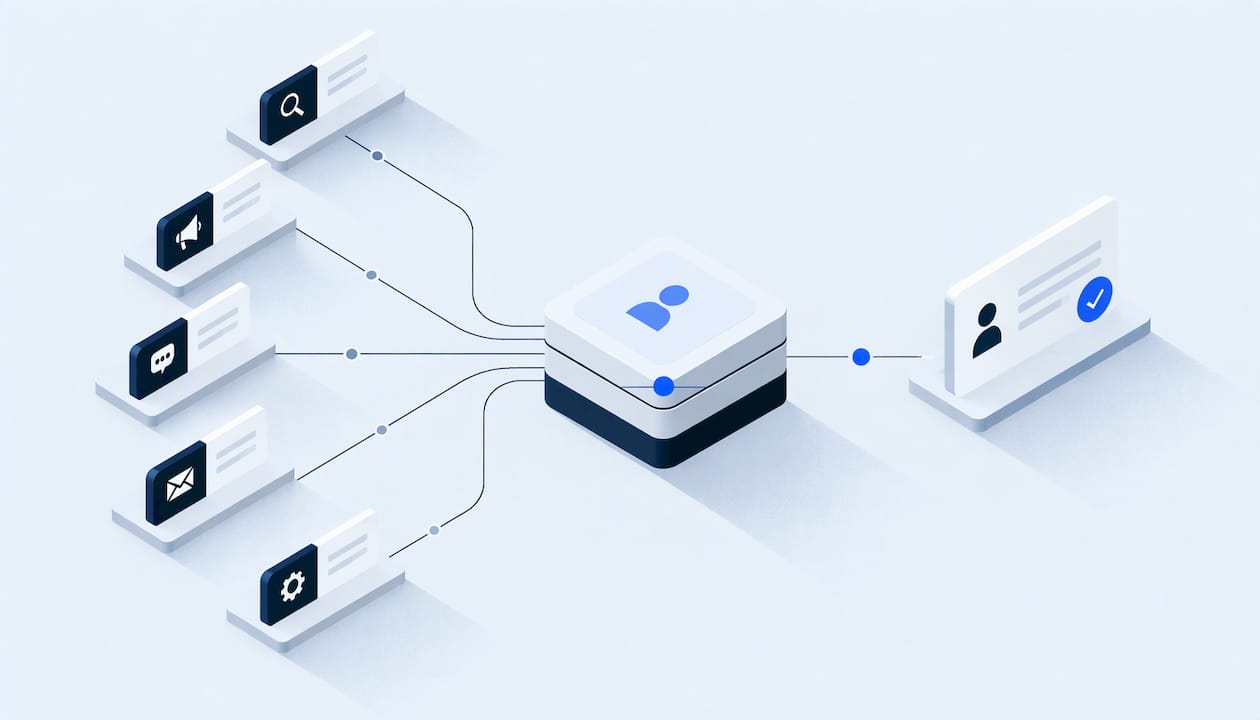
Lead source attribution means recording where each lead came from and tying that source to what happened next: a booked job, an invoice, revenue. For a service business, the setup comes down to four things: a tracked phone number for every channel, a form that captures the source, one CRM field that holds it, and a rule for which system wins when reports disagree. The rest of this guide shows how to build that, step by step.
TL;DR
- A lead source is the channel where someone first met your business. Attribution connects that channel to outcomes such as booked jobs and revenue, not just form fills.
- Pick one attribution model on purpose. The model you choose changes your lead count and your cost per lead.
- Track calls first. In HVAC, plumbing, roofing and restoration, the phone is usually where the lead arrives.
- Store source in one CRM field at the record level, keep campaign detail in a second field, and lock the allowed values.
- Audit duplicates and blank source fields monthly. Attribution reports are only as good as the records under them.
Table of Contents
- What lead source attribution actually means
- Why attribution matters more when the phone rings
- Choose an attribution model before you read a report
- How to track leads across calls, forms, referrals and walk-ins
- Organize source data in your CRM
- Why your reports will disagree, and what to do
- Turn attribution into spending decisions
- Perspective
- Where Equinox fits
- A starter checklist
- FAQ
- Sources
What lead source attribution actually means
A lead source is the channel through which a potential customer first interacts with your business, such as a paid ad, a Google search or a referral, as Shopify's explanation of lead sources puts it. Attribution is the next step: assigning credit for the lead to that origin, and then following the lead to the outcome.
Two distinctions save a lot of confusion.
Source versus method. The lead source is where the lead started. The lead method is how you first reached them. If a homeowner finds your website through a search engine and you call them back, the search engine is the source and the phone call is the method. Mixing the two up is the most common reason a source report looks odd.
Source versus campaign. Source is the broad channel: paid search, Google Business Profile, referral, yard sign, repeat customer. Campaign is the specific effort inside that channel: a spring AC tune-up ad group, a storm-season roofing landing page. Most CRMs let you keep both, and you should.

Why attribution matters more when the phone rings
Online retailers can lean on a click and a cart. You can't. A homeowner with a burst pipe sees your ad, taps the number and talks to your front desk. No form, no session recorded against a name. Unless something captures the source at that moment, the lead lands in your CRM as "phone" or "unknown," and your marketing report undercounts the channel that paid for it.
That gap is where budgets go wrong. If calls are invisible, the channels that drive them look weak, and you cut the thing that works. A clean attribution setup answers questions an owner actually asks:
- Which channel produces booked jobs, not just inquiries?
- Which ad group brings emergency calls versus tire-kickers?
- Are referrals closing at a higher rate than paid leads?
- Are leads going cold because nobody called back in time?
Choose an attribution model before you read a report
An attribution model is the rule for who gets credit. CallRail's attribution modeling documentation lists five models used in call and lead reporting:
| Model | How credit is assigned |
|---|---|
| First Touch | 100% to the first touchpoint |
| Lead Creation | 100% to the last touchpoint before the person became a raw lead |
| 50/50 | Split evenly between First Touch and Lead Creation |
| Qualified | 100% to the last touchpoint before the lead became qualified |
| W-Shaped | One-third each to First Touch, Lead Creation and Qualified |
Broader marketing literature also describes linear (equal credit to every touch), time decay (more credit closer to conversion), position-based or U-shaped, and data-driven models. For most local service companies, the single-touch and two-touch options are enough, because the buying journey is short and a lot of it happens offline.
How the model changes your numbers
The model is not cosmetic. Under a multi-touch model such as 50/50, each touchpoint earns only partial credit for a lead, so your total lead count and your cost per lead will differ from a single-touch view. The same ad spend can look efficient in one report and expensive in another. Decide which question you are answering:
- "Where do new customers first find us?" Use first touch.
- "What made them finally call?" Use last touch or lead creation.
- "Which channels produce qualified jobs?" Use a qualified-lead model, which requires you to mark qualification in the CRM.
Write the choice down and use it in every report for at least a quarter. Switching models mid-stream makes trends meaningless.
How to track leads across calls, forms, referrals and walk-ins
Every lead path needs a way to leave a source behind. Here is the setup, in the order that tends to pay off fastest.
1. Calls: one tracked number per channel
Give each major channel its own tracking number: Google Ads, your Google Business Profile, the website, direct mail, vehicle wraps. Calls to each number are logged with the channel, and the number can be forwarded to your real line. Keep your business name, address and main phone number consistent in public listings so tracking doesn't muddy your local presence. Our call tracking setup guide for service businesses walks through the numbers, the forwarding and the naming. If you run Google Ads, the Data Manager integration for CRM covers passing call data to your CRM securely.
2. Web forms: capture source in hidden fields
Tag every ad and campaign link with UTM parameters (source, medium, campaign). Add hidden fields to each form so those values travel with the submission into the CRM. Also capture the landing page. A form that stores only name, phone and message throws away the most valuable thing you could know about the lead.
3. Referrals and repeat customers: ask once, store it
Offline sources only get recorded if someone asks. Add a required "How did you hear about us?" field with a short list of choices for your front desk or dispatcher: Google search, Google Maps, referral from a customer, referral from an insurance agent or property manager, truck or yard sign, repeat customer, other. When the answer is a referral, add a free-text field for the referrer's name so you can thank them and measure the channel.
4. Texts, chats and missed calls
Two-way text and chat are lead sources too, and missed calls are leads you haven't talked to yet. Log them with the same source field as everything else. If outbound texting is part of your follow-up, make sure your messaging registration is correct first; our guide to A2P 10DLC registration and EIN mismatches covers the usual causes of blocked messages.
5. Walk-ins and word of mouth
Whoever creates the record owns the source field. Make it required at creation, not something to fill in later. A field that is optional is a field that ends up blank.
If you want another look at how a tracking setup is structured in a different industry, this lead source tracking setup walkthrough shows the same principle of capturing source at the first touch.
Organize source data in your CRM
In systems such as Salesforce and HubSpot, source data is stored at the record level and persists through the customer lifecycle, so a large job can be traced back to the original channel months later. Salesforce, for example, uses a single standard value set that maps to the Lead, Contact, Opportunity, Account and campaign member objects. The point for you: source should follow the customer from lead to job to invoice without being retyped.
A workable field design:
- Lead Source (picklist, required): Paid Search, Google Business Profile, Organic Search, Referral, Repeat Customer, Direct Mail, Yard Sign or Vehicle, Other.
- Campaign (picklist or text with a naming rule): the specific effort, such as "spring-tuneup-search."
- Referrer name (text, shown only when source is Referral).
- First-touch date and qualified date, so you can apply a qualified model later.
- Booked job and revenue fields, or a link to the invoice in your dispatch system.
Lock the picklist. When staff can type "google," "Google," "G ads" and "adwords," you get four channels that should be one. Stage definitions matter just as much, because a qualified model depends on a clear definition of qualified; see our guide to pipeline stage design for service business deals. And once source flows into your pipeline, pipeline reporting for service businesses shows what to measure on top of it.
Why your reports will disagree, and what to do
Expect conflict. Different tools measure different things. In home services, a web analytics tool sees a website session, a call tracker sees an inbound call, the dispatch system sees the booked job and revenue, and ad platforms claim conversions using their own rules. Each uses its own window and definition of a conversion. The workable answer is to pick one system of record and reconcile the others against it. For most service companies, that system of record is the CRM or dispatch platform, because it holds the job and the money.

Reports also conflict because marketing and sales often count different objects (lead, contact, account, opportunity) and different dates (touch date, stage date, close date), as the Pedowitz Group's explanation of conflicting attribution reports describes. Agree on definitions in writing: what counts as a lead, what counts as a booked job, which date a job is credited on.
Audit the data under the report
One data-quality analysis suggests that duplicate rates of 10 to 30 percent are common in B2B databases and that lead source accuracy often sits around 60 to 75 percent, against a target of 90 percent or better. Those figures come from B2B databases, so treat them as a warning, not a benchmark for your shop. The direction holds for any CRM: duplicates split one customer's history across two records, and blank source fields hide the channel entirely.
A monthly check takes under an hour:
- How many new records this month have a blank or "Other" source?
- How many phone numbers appear on more than one record?
- Do the call tracker's call counts roughly match the CRM's phone leads?
- Do the booked jobs in dispatch each carry a source?
- Has anyone added a new picklist value or campaign name that breaks the naming rule?
If the answers are bad, clean before you analyze. Our guide to setting CRM data quality rules before you merge records lays out the order of operations, and the 500-row match test for lead data enrichment shows how to check a change on a sample before it touches everything.
Turn attribution into spending decisions
Once source is reliable, a small set of numbers does most of the work. For each channel, per month:
- Leads, and how many were answered live
- Booked jobs and booking rate
- Revenue from those jobs
- Spend, cost per lead and cost per booked job
Cost per lead is the metric attribution models distort most, as shown above. Cost per booked job and revenue per channel are harder to game. For a primer on picking indicators to put on a dashboard, this overview of marketing KPIs to track is a reasonable companion.
Attribution tells you which channels are associated with jobs. It does not prove a channel caused them. Multi-touch reports show influence, which is directional, while causal budget calls are better made with tests, such as pausing a channel in one area for a few weeks. That split between directional and causal measurement is worth keeping in mind before you cut a line item on the strength of one report.
Speed matters alongside source. A channel can look poor because nobody picked up. Check answer rate and time to first response by source before you blame the ads.
Perspective
Most attribution projects fail at the seams, not in the report. The call tracker knows one thing, the form tool knows another, the CRM knows a third, and the dispatch system holds the revenue. Nobody owns the handoffs, so the source gets lost exactly where the customer moves from one system to the next.
Our view is that attribution is a build problem before it is an analytics problem. Every project we take on is scoped and documented first: where each lead enters, which field stores its source, who can change it, and what happens when a record is merged. We write that down as a data map, give each integration least-privilege access, and plan how to roll back if a change misbehaves.
That is also why we care about voice and follow-up. A missed call is a lead with no source and no next step. When an AI voice agent answers, qualifies the inquiry and writes the source into the same record the calendar and reporting use, the lead is counted once and followed up consistently. A single accountable technical lead owns that whole chain, so there is one person to ask when a number looks wrong.
Start simple: one source field, one naming rule, one system of record. Add sophistication only after the basics hold for a few months.
Felix
Where Equinox fits
If your leads arrive by phone, form, text and referral and end up in different places, the fix is usually integration, not another dashboard. We build lead systems, AI voice and messaging agents, and done-for-you automations for US service businesses, with unified customer records, calendars and reporting underneath. Each build is scoped and documented, and designed with security in mind. See how our lead generation and automation services work or go straight to our process.

If you want a second pair of eyes on where your leads lose their source today, the Equinox Strategies site is the place to start a conversation.
A starter checklist
- Choose an attribution model and write it down.
- Assign tracked numbers to each paid and local channel.
- Add UTM tags and hidden source fields to every form.
- Make "How did you hear about us?" required for phone and walk-in leads.
- Create one locked Lead Source picklist and a campaign naming rule.
- Name the system of record and reconcile other tools to it.
- Run the monthly audit for blanks, duplicates and broken integrations.
- Review cost per booked job by source, not only cost per lead.
FAQ
What is the difference between lead source and lead attribution?
Lead source is the channel where a lead first came from. Lead attribution is the process of assigning credit to that source, or to several touchpoints, and connecting it to results such as booked jobs and revenue. Source is the data point, attribution is the method that uses it.
What are examples of lead sources for a service business?
Common ones are paid search, Google Business Profile, organic search, customer referrals, referrals from property managers or insurance agents, repeat customers, direct mail, yard signs and vehicle wraps. Keep the list short and fixed so reports stay consistent.
Which attribution model should a small service company use?
Start with first touch or lead creation, since the buying journey is short. Move to a qualified-lead model when your CRM reliably marks which leads were real opportunities. Whatever you choose, remember that the model changes your lead count and cost per lead, so keep it constant while you compare periods.
How do I track offline leads like referrals and walk-ins?
Make a source question mandatory when the record is created, with a fixed list of answers and a free-text referrer name. Offline sources are only captured when a person asks and enters the answer, so build it into the intake script.
Sources
- What Is a Lead Source? How To Track and Use Lead Sources, Shopify
- What Are Lead Sources?, Business News Daily
- Attribution modeling, CallRail Help Center
- StandardValueSet Names and Standard Picklist Fields, Salesforce Developer Docs
- Marketing attribution for home services, Sheppard CG
- Why do our attribution reports conflict with sales data?, Pedowitz Group
- Multi-Touch Attribution: Why Your Data Source Matters More, Cleanlist
- Lead Source Tracking for Dealers: A Practical Setup, Loturn
- Top 7 Marketing KPIs You Should Be Tracking, Christian Steven