
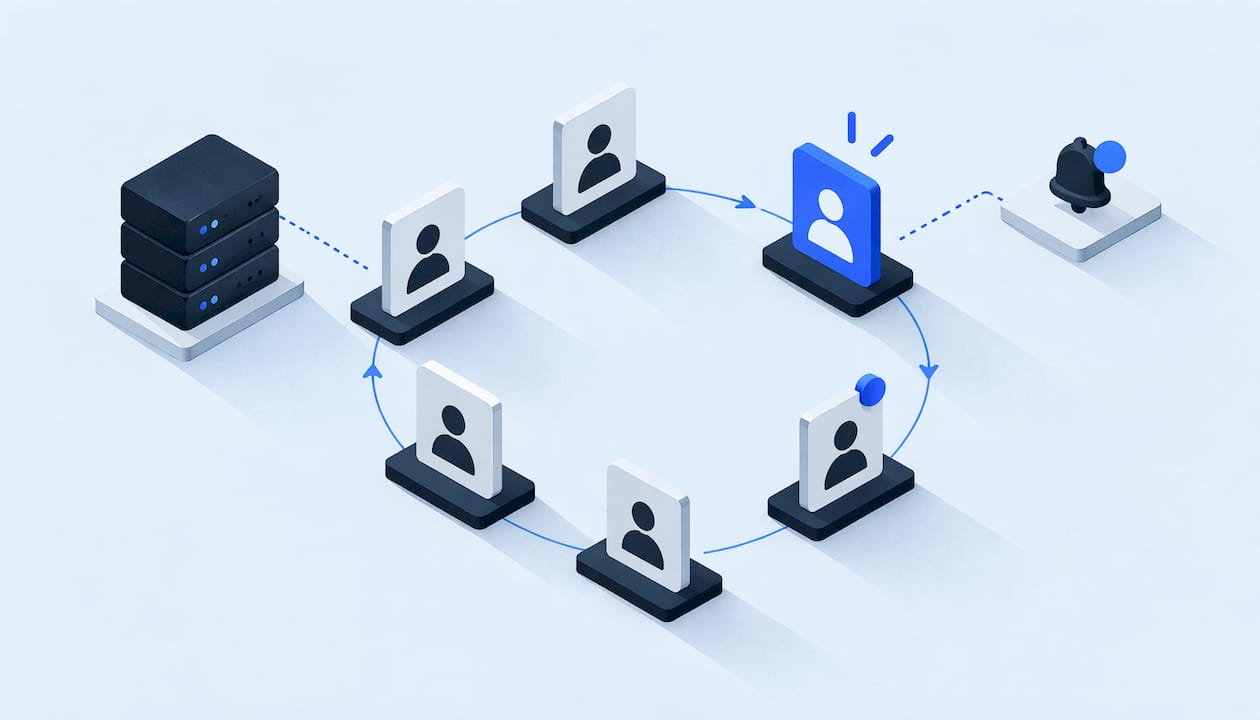
To set up an on-call rotation, decide which calls count as emergencies, name a primary and a backup for every shift, rotate weekly among at least four to six people, and write down handoffs, swaps and response times before the first shift starts. Do it in that order. Most rotations fail because the schedule was built first and the rules came later.
This guide is written for owners and operations managers at HVAC, plumbing, roofing, restoration and general contracting companies, where the phone rings at 2 a.m. and a missed call is a lost job. Much of the best on-call advice comes from software teams. We have adapted it to trucks, dispatchers and front desks.
TL;DR
- Sort inbound calls into tiers first. Only true emergencies wake someone up; urgent but stable issues wait for the morning with clear instructions to the caller.
- Every shift needs a named primary and a named backup, plus a last-resort escalation step. Write the rotation at least four weeks ahead.
- Aim for a pool of six to eight people where you can. With four, weekly rotation is the floor. Hand off at a fixed weekday and hour.
- Handle swaps as formal changes and use overrides for last-minute gaps, so the base rotation stays correct.
- Put response times, pay and escalation in a written policy, and check pay rules against federal and state law before you publish.
Table of Contents
- Start with what the rotation covers
- Set response-time standards customers can see
- Name a primary, a backup and an escalation path
- Choose rotation length and team size
- Build the schedule step by step
- Handle swaps, time off and overrides
- Know the US labor rules before you promise pay
- Write the on-call policy
- Review the rotation monthly
- Take the routing off your people
- FAQ
- Sources
Start with what the rotation covers
Before anyone gets a calendar invite, define what "on call" means for your business. Two decisions drive everything else: which calls justify a response outside business hours, and which hours the rotation covers.
Contractor Magazine recommends classifying calls into tiers and responding to each tier by rule. Its example: a true emergency, such as a water or sewage threat to property or safety, is dispatch-now. An urgent but stable issue becomes a first-thing-tomorrow job, with clear overnight instructions for the customer. The same article makes a sharper point: the classification is the product. You standardize the questions the person answering the phone asks, then apply the matching rule, rather than inventing a phone tree for every case.
A workable tier table for a home service company looks like this:
| Tier | Example calls | Response rule |
|---|---|---|
| 1: Emergency | Active flooding, sewage backup, gas smell, no heat with vulnerable occupants, storm-opened roof | Dispatch now; on-call technician is paged |
| 2: Urgent, stable | Slow leak contained with a shutoff, AC down on a mild night, minor roof drip | Customer gets overnight instructions; first slot next morning |
| 3: Routine | Quotes, maintenance, estimates, scheduling | Business hours; captured and followed up automatically |
These examples are illustrations, not a standard. Adjust them to your trade and your service area. Restoration companies will treat far more calls as Tier 1 than a roofing contractor will.
Then pick your coverage window. Many shops define after-hours as the stretch between close of business and opening. A sample from FitSmallBusiness sets after-hours as 7 p.m. to 7 a.m. and splits it between two dispatchers, one covering 7 p.m. to 1 a.m. and one covering 1 a.m. to 7 a.m. Weekends and holidays need their own line in the plan.
Set response-time standards customers can see
A rotation without a response target is just a list of names. Contractor Magazine suggests a standard of a callback within 30 minutes and a truck on site within two hours anywhere in the core service area, and notes that publishing it gives customers a real answer and gives you a way to measure yourself.
Two cautions on setting yours. First, state operating targets, not personal guarantees. The author of the oncall.fyi template points out that tooling, connectivity and human availability all sit between an alert and an acknowledgment, so targets belong in the policy rather than promises. Second, response time affects pay. FirstHR notes that response time matters for coverage reliability and whether on-call time is paid. More on that below.
If you want to track whether the standard holds, our guide to call center KPIs for service businesses covers the metrics that matter. For a broader look at response expectations during serious outages, an incident response checklist shows how larger organizations frame service levels.
Name a primary, a backup and an escalation path
The rule that prevents most 2 a.m. chaos: every primary has a named backup. Contractor Magazine recommends writing the rotation at least four weeks out and pairing each primary with a named backup, so nobody has to call the owner to find out who is up.
Software teams formalize this as an escalation path with three parts. Incident.io describes a primary responder, a secondary paged if the primary does not acknowledge within a set wait time, and a fallback such as a manager or incident commander if both go unanswered. One on-call platform's documentation gives a concrete example: if the primary does not acknowledge within 30 minutes, the alert escalates to the secondary. Thirty minutes is too long for a flooded basement. Set your own wait to match your callback standard.
For a field company, translate it like this:
- Primary: the on-call technician or dispatcher who answers or receives the page.
- Backup: a named second person, ideally in a different part of town, who is paged if the primary does not acknowledge in a few minutes.
- Last resort: the service manager or owner, reached only when both have failed.
Keep the chain short. The Truss Engineering Playbook recommends a primary, a secondary and a tertiary backstop, usually a lead, and treats a limited chain as part of reducing fatigue.
How the call reaches the person matters as much as who it reaches. If your after-hours line rings a single cell phone, one dead battery breaks the chain. Our piece on call transfer strategy explains warm, cold and live-agent handoffs, and our guide to round robin assignment shows how to distribute inbound work fairly across a team.
Choose rotation length and team size
Team size decides your schedule more than preference does. Datadog says team size largely determines rotation structure, and it generally aims for six to eight engineers per rotation so each person serves no more than about once a month. The Truss playbook agrees with six to eight for most cases and says in almost no case should the pool be below four or above twelve.
A few benchmarks to anchor your design:
- Weekly rotation is the common default for small teams. A ToolkitCafe policy template sets a minimum of four people for weekly rotation, no more than one week in three on call, and no more than seven consecutive days as primary.
- Rest between shifts: FireHydrant's documentation recommends at least two weeks between shifts for the same person, ideally one week on and three off, and avoiding consecutive weeks.
- Shift length for split coverage: Datadog says shifts generally run between eight and 12 hours, with smaller teams using shorter shifts to reduce fatigue.
Two worked examples from FitSmallBusiness show what this looks like in trades. A plumbing company with six emergency plumbers, each on call for one week, produces a five-week break between shifts. A dispatcher rotation with two overnight halves leaves each dispatcher a three-day gap between on-call shifts.
If you have only three technicians, the math does not work without help. Options include pairing technicians with dispatchers in a split model (dispatcher takes the first call, technician is paged only for Tier 1), or letting an automated after-hours answering layer handle classification so the human on call is woken only when needed. We return to that in the promo below.

New hires and holidays
The ToolkitCafe template adds two rules worth borrowing: new hires shadow two rotations before going primary, and holiday coverage is rotated separately and tracked across the year so the same person does not get every Thanksgiving. Either rule can be adapted to a seasonal trade, where a July heat wave or a January freeze puts the whole rotation under strain.
Build the schedule step by step
Here is the sequence we would follow for a company starting from nothing.
- List the tiers and the coverage window. Use the table above.
- List eligible people. Webalert advises including only those who can actually respond: they have access, know the system and are willing. For a field company, that means licensed, equipped and trained.
- Choose a handoff time. Runframe suggests a time when the outgoing person can transfer context and the incoming person is awake and ready, and a 15 to 30 minute overlap for the handoff. Monday morning at a fixed hour works for many shops, since it lines up with the weekly job board.
- Fix the order. Webalert recommends that each slot have a clear start and end and that the rotation logic leave no ambiguity.
- Enter it in a tool. A shared calendar can work for a small team. Dedicated scheduling software helps once you have several people. One platform's documentation walks through creating a shift-based schedule: name it, pick a template (weekly handoff, workday/weekend, follow the sun or custom), set time zone, rotation frequency, active days and times, and the handoff time, then add members.
- Publish four weeks ahead. This gives people time to plan around it and to arrange swaps.
For the dispatch side of the day, a field service scheduling guide helps you fit on-call duty around regular routes and workload. We also cover how booking rules interact with after-hours work in scheduling policies for service businesses.
What a good handoff contains
Runframe's handoff practices translate directly to the trades. Document open jobs with status and next steps, flag what is fragile or in progress (a temporary repair, a tarped roof, drying equipment still running), and transfer ownership explicitly. A short written note beats a verbal "nothing much happened."
Handle swaps, time off and overrides
People get sick, kids get sick, and trucks break down. Decide in advance how changes work.
Grafana's documentation distinguishes two tools. A shift swap exchanges shifts between two people and keeps the rotation intact, which makes it easy to track and audit. An override replaces the scheduled person for a one-time exception without altering the underlying rotation. Its recommendation: prefer swaps for planned changes and keep overrides for last-minute coverage.
The GitLab Handbook adds a useful norm for time off: two to four weeks' notice is ideal, and an override can be used for holidays, illness or schedule errors. The ToolkitCafe template turns that into a rule: swaps need manager approval and 48 hours' notice.
A simple swap rule for a field company:
- Planned swap: both people agree, the manager approves, and it is logged at least 48 hours ahead.
- Emergency gap: the manager or dispatcher assigns an override and the backup covers until it is entered.
- Nobody trades shifts by text message without the schedule being updated, because the page or call will still go to the old name.
Know the US labor rules before you promise pay
On-call pay is a legal question, not only a policy one, and the answer depends on how restricted the employee is. Under the federal rule in 29 CFR 785.17, as summarized by the National Law Review, an employee who must remain on the employer's premises, or so close that personal time cannot be used effectively, is working while on call. An employee required only to carry a phone or leave word where they can be reached is, in most cases, not working while on call. That article addresses healthcare, but it cites the general federal regulation.
Two practical implications. Tight response targets (for example, be at the shop within minutes) push toward compensable time. And hours actually worked on a call-out count toward the workweek, so a technician who works a night call-out can cross into overtime territory. Some states have rules stricter than federal law, so confirm pay, rest and overtime treatment with your state labor department or an employment attorney before you finalize the policy. For reference, one public university's policy pays specified non-exempt staff a flat weekly amount for on-call duty and pays call-in work at straight time or time-and-a-half depending on weekly hours; that is one employer's rule, not a legal standard for yours.
Write the on-call policy
A written policy settles disputes before they start. FirstHR says it should specify who is subject to duty and how the rotation works, expected response times and contact methods, pay for on-call time and time worked, swaps, what to do if the primary is unreachable, and equipment provided. Keep it alongside your employee handbook.
If you want a template skeleton, the oncall.fyi template runs through thirteen sections: purpose, scope, roles, schedule, pre-shift readiness, response expectations, escalation, handoff, compensation and recovery, safety and wellbeing, training, review and approval. For a service business, we would keep all thirteen but rewrite the language around trucks, tools and customers. Give it an owner, a review date and a record of approval. Two sections deserve real work: compensation and recovery (check against contracts and local requirements) and response expectations.
A minimum viable version for a ten-person company fits on two pages:
- Scope: which call tiers trigger a page, and the coverage window.
- Roles: primary, backup, last resort, and who owns the schedule.
- Response: callback and arrival targets.
- Escalation: how long before the backup is paged.
- Swaps and time off: notice and approval.
- Pay and rest: as confirmed with your attorney.
- Review: monthly check of the numbers, annual revision.
Review the rotation monthly
A rotation is never finished. Webalert recommends reviewing pages, overnight interruptions, acknowledgments, swaps, escalations and recovery by person, then adjusting staffing, ownership or shift boundaries. ToolkitCafe's template suggests monthly metric reviews, quarterly check-ins with the people on call, and an annual look at rotation and compensation. For a field company, count after-hours calls by tier, how many reached a human on the first try, how many needed the backup, and how many Tier 2 calls were really Tier 1. If one person takes most of the escalations, the rotation is not as fair as it looks on paper.
Perspective
Most missed after-hours leads are not caused by a lazy technician. They come from a rotation that depends on one phone, one person's memory and a schedule nobody can see.
We scope every build the same way: written maps of who gets contacted and when, least-privilege access, explicit consent flows and rollback plans, handled by one accountable technical lead. Apply that thinking to on call. Document the tiers, document the escalation path, and make the system do the routing so people do not have to.
That is why our voice and messaging agents are designed to answer, qualify the inquiry and hand a real emergency to the right person, while routine inquiries get automated follow-up. The goal is a rotation where the human on call is woken only for what truly needs a human.
Felix
Take the routing off your people
A rotation decides who responds. It does not answer the phone at 11 p.m., sort a quote request from a burst pipe, or follow up on the lead that called while everyone was on a job. That is the part we build. Equinox Strategies designs AI voice and messaging agents, done-for-you automations and lead systems for US service businesses, with voice answering, inquiry qualification, automated follow-up and unified customer records and calendars. See what we build and how we scope it or start from our process.

If your rotation depends on a single phone or a front desk that is already overloaded, a conversation about routing is a good first step. Our automated appointment scheduling guide shows what the follow-up side looks like.
FAQ
How many people do I need for an on-call rotation?
Four is the practical minimum for weekly rotation, and six to eight is the range several sources recommend so each person is on call about once a month. If you have fewer, split the duty between dispatchers and technicians or reduce how many calls reach a human overnight.
How long should each on-call shift be?
Weekly rotations are the common default for small teams. If you split nights, shifts of eight to 12 hours are typical, and smaller teams tend to use shorter ones to limit fatigue. Whatever you pick, hand off at a fixed day and time.
Do I have to pay employees for being on call?
It depends. Under the federal rule, time is generally compensable when the employee's freedom is so restricted that personal use of the time is not feasible, while carrying a phone alone usually is not. Hours actually worked on a call-out count. State rules can be stricter, so confirm with your state labor department or an employment attorney.
What should an on-call policy template include?
Cover scope, roles, the schedule, response expectations, escalation, handoff, swaps, pay and recovery, training and a review date. Replace every placeholder with your own numbers, and have someone check the pay section against current law.
Sources
- Build an Emergency Call Dispatch Playbook Before You Need It, Contractor Magazine
- On-call Scheduling: Implementation Steps, FitSmallBusiness
- On-Call Policy Template, oncall.fyi
- How to Create an On-Call Schedule: A Guide, FirstHR
- Incident escalation policies guide, incident.io
- Escalation Policies and Schedules, PagerDuty Docs
- On-Call Best Practices, Truss Engineering Playbook
- How we structure on-call rotations at Datadog
- IT On-Call Policy Template, ToolkitCafe
- On-Call Schedule Best Practices, FireHydrant
- On-Call Schedule and Rotation Setup Guide, Webalert
- On-Call Scheduling Guide, Runframe
- Shift-Based Schedules, PagerDuty Docs
- Best practices for on-call schedules, Grafana Cloud
- Coverage and Scheduling, The GitLab Handbook
- Fair Labor Standards Act in Healthcare Settings, National Law Review
- On Call Responsibility and Pay, Tarleton State University
- Enterprise incident response checklist guide
- Field service scheduling guide for dispatchers