
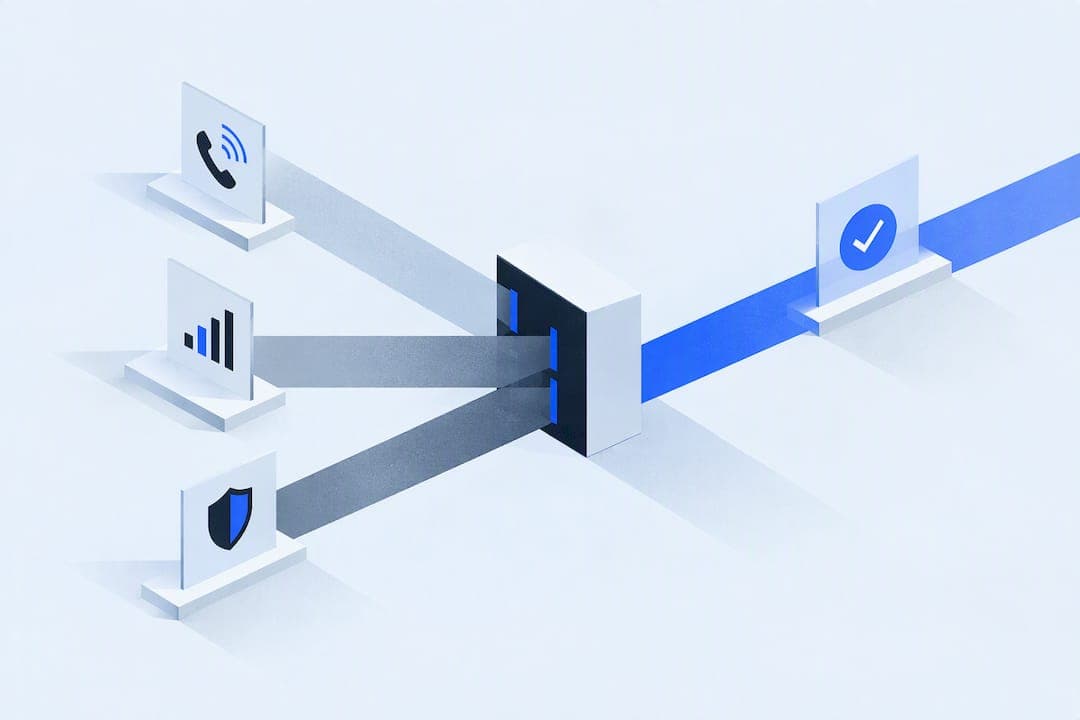
Caller ID reputation is how carriers and call-blocking apps judge an outbound number, combining whether the call is technically authenticated with whether it behaves like wanted traffic. The immediate move when a number underperforms is to audit it across carriers and pause the campaign if it is already flagged. Monitoring first tells you whether the problem is authentication, behavior, or both before you spend time fixing the wrong thing.
TL;DR:
- STIR/SHAKEN confirms caller ID authenticity, but carriers also weigh attestation, call volume, complaint rates, wrong party calls, and third party reputation signals.
- Spoofing requires provider verification and reporting, while volume bursts call for throttling; recycled numbers and stale or unconsented lists require separate cleanup.
- Test each number across multiple carriers and devices, then log the network, handset, displayed label, and test date to compare results over time.
- After a flag, pause or throttle dialing, verify ownership and signing, remove invalid contacts, adjust pacing, and retest; no provider guarantees when labels clear.
- Prevent repeat flags by using valid assigned numbers, setting per minute caps, honoring business hours and opt outs, and routing new alerts to human review.
Table of Contents
- Authentication Is Not the Same as Reputation
- How Carriers and Apps Decide What Label You Get
- Common Reasons a Number Gets Flagged as Spam
- How to Audit and Monitor Your Caller ID Reputation
- The Remediation Sequence That Actually Restores a Number
- Dialing Habits That Keep Numbers Off the Spam List
- Building Reputation Monitoring Into Secure Automations
- Where AI Voice Agents Fit Into Reputation Protection
- Quick Wins and Strategic Priorities
- Done-for-You Monitoring and Remediation Automations
- FAQ
- Sources
Authentication Is Not the Same as Reputation
Caller ID authentication and caller ID reputation solve different problems, and confusing them wastes remediation effort. STIR/SHAKEN verifies that the caller ID displayed matches the number that actually originated the call on IP networks, but it does not by itself keep a number off a spam list. The Federal Communications Commission is explicit that carriers and call-blocking apps use this authentication data alongside separate analytics and complaint signals to decide what label a call receives.
That distinction matters for connection rates. A fully authenticated number can still get flagged "Spam Likely" if it dials at high volume or triggers complaints, and a business relying only on signing calls correctly can still watch answer rates drop.
- Authentication proves the caller ID is not spoofed.
- Reputation scoring layers behavioral signals on top of that proof.
- Losing either layer can suppress connection rates and cost leads.
How Carriers and Apps Decide What Label You Get
Labeling decisions blend three inputs: attestation level, calling analytics, and third-party reputation data. Attestation comes in three tiers, generally described as A, B, and C, where A-level attestation means the provider can fully verify the caller and the number association, while lower levels signal less certainty. Recent FCC rulemaking clarifies when providers may apply third-party authentication and how attestation decisions must be documented.
Analytics engines separately track volume patterns, complaint rates, and wrong-party call ratios, then feed that into labeling apps and carrier dashboards.
- Attestation level signals how confident the originating provider is in the caller identity.
- Volume spikes and repeated short calls read as robocall behavior even when legitimate.
- Complaint flags from recipients and blocking apps carry independent weight.
STIR/SHAKEN compliance now includes documented robocall mitigation plans which the FCC requires providers to file, giving businesses a paper trail to point to during disputes.
Common Reasons a Number Gets Flagged as Spam
Most flagged numbers fall into a handful of recognizable patterns, and identifying which one applies determines the fix.
- Spoofing or unauthorized caller ID use, where a number appears on calls it never actually originated, often triggering complaints tied to an unrelated business.
- High-volume bursts, rapid retries, or wrong-party dialing, which read to analytics engines as robocall behavior even when a live agent is on the line.
- Recycled or shared numbers with poor prior history, inherited from a previous tenant, along with stale or unconsented contact lists that generate complaints.
Each cause points to a different fix: spoofing needs provider verification and reporting, volume issues need throttling, and list quality needs cleanup before any number gets reused.
How to Audit and Monitor Your Caller ID Reputation
A reliable audit treats labeling as something to measure across environments, not assume from a single result. Test the same outbound number from multiple carriers and multiple handsets, since a flag on one network does not guarantee the same flag elsewhere. Log carrier, device, label shown, and the date and time of each test so you have a comparable record.
- Run multi-carrier, multi-device test calls and record every result.
- Check carrier-specific dashboards where providers expose reputation data.
- Use aggregator and public lookup tools to catch labels your own tests miss.
- Set automated alerts so a new flag triggers a review rather than going unnoticed.
Feeding those alerts into a ticketing or automation workflow turns a one-time check into continuous coverage, which matters because labels can change without warning.
Pro Tip: Keep a rolling log of every test result by carrier and date, since providers and aggregators often ask for that history before they will investigate a remediation request.
The Remediation Sequence That Actually Restores a Number
Fixing a flagged number works best as a sequence, not a scramble, because each step either reduces the signal causing the flag or gives you evidence for the next one.
- Pause or throttle the campaign to immediately cut the volume generating complaint signals.
- Verify ownership, CNAM, and STIR/SHAKEN signing with your provider to confirm the number is correctly attested.
- Audit consent and Do Not Call suppression, removing stale or unconsented contacts from the list.
- Clean the list for wrong-party and outdated records that drive hang-ups and complaints.
- Smooth the retry rate and call pacing before resuming any outbound push.
- Retest across carriers, document results, and submit evidence to your provider or the relevant aggregator if the flag persists.
| Step | Goal | Evidence to keep |
|---|---|---|
| Pause campaign | Stop new complaint signals | Pause date and volume before stop |
| Verify authentication | Confirm correct attestation | Provider confirmation of signing |
| Clean consent lists | Remove unconsented contacts | Updated suppression list |
| Retest and document | Confirm label change | Carrier, device, label, date |
No provider or FCC guidance sets a guaranteed timeline for a flag to clear, since each carrier and analytics vendor runs its own review process.
Dialing Habits That Keep Numbers Off the Spam List
Prevention is cheaper than remediation, and most of it comes down to dialing discipline rather than technology. The FCC recommends using only valid, assigned numbers and limiting calls per minute, since unassigned or invalid caller IDs are explicitly eligible for blocking.
- Dedicate separate numbers to distinct campaign types instead of mixing sales and support traffic on one line.
- Cap calls per minute and avoid bursts outside normal business hours.
- Use a consistent caller name and a clear voicemail greeting with an easy callback path.
- Maintain consent records and act on opt-outs immediately rather than batching them.
A checklist for running AI-assisted outbound pilots covers how to layer consent and testing controls into a new calling program from day one.
Building Reputation Monitoring Into Secure Automations
Monitoring only helps when it connects to a response, which is why we treat reputation alerts as a workflow trigger rather than a dashboard to check manually.
- Route a new flag alert into an automated pause, followed by a manual review step before any resume.
- Apply least-privilege access to phone number provisioning so only approved roles can activate or reassign a line.
- Keep an auditable change trail of every provisioning action and every remediation step taken.
That structure mirrors how we scope any automation project: documented data flows, explicit consent handling, and a rollback plan if a change needs to be reversed. A stable, verified web presence also supports caller trust, which is part of why profile verification practices matter alongside phone-side fixes.
Where AI Voice Agents Fit Into Reputation Protection
AI voice agents change the reputation equation mainly by controlling the behavioral signals that trigger flags in the first place. A well-configured voice agent paces outbound calls consistently, avoids the rapid-retry patterns that read as robocall bursts, and can be set to respect business hours and call-per-minute limits without manual oversight on every batch.
Voice agents also help on the inbound side, where a consistent, clearly identified greeting reduces the wrong-party confusion and hang-ups that feed complaint-based analytics. When a number does get flagged, an agent-driven workflow can pause outbound dialing on that line automatically and route the flag to a human for review, which is faster than someone noticing a drop in answer rates days later.
The same logic applies to lead generation and follow-up automation more broadly. When voice agents, texting, and scheduling are tied into one system, a reputation issue on one number does not have to stall the whole follow-up pipeline, since calls can shift to a backup line while the flagged number goes through remediation. That kind of fallback only works if the monitoring and the dialing system are built to talk to each other, which is an architecture decision made before a flag ever happens, not after.

Quick Wins and Strategic Priorities
Monitor before you fix anything else: a flag with no diagnosis just leads to guessing. Fix authentication and calling behavior together, since one without the other leaves the underlying cause in place. The lasting improvements come from teams that treat every flag as a test result worth logging, not a one-off emergency to clear and forget.
— Felix
Done-for-You Monitoring and Remediation Automations
We build systems that include monitoring feeding into an automated pause, a human review step, and a documented remediation playbook, so a flagged number gets caught and handled without someone watching a dashboard all day. Our lead generation, AI voice agents, and automation builds are scoped and documented from the start, with least-privilege access controls on every phone provisioning step and a clear rollback plan if anything needs to change.

If your outbound calls are losing answer rates and you want a system that catches that before it costs you leads, reach out through our site to schedule a discovery call.
FAQ
How can I check the reputation of my phone number?
Place test calls to multiple carriers and devices, recording the carrier, device, label shown, and the date of each test. Carrier dashboards and third-party aggregator lookup tools can catch labels your own tests miss, especially on networks you don't personally use.
Why can't you trust caller ID?
Caller ID can be falsified through spoofing, where the displayed number does not match the actual originating line, which the Truth in Caller ID Act prohibits when done with intent to defraud or harm. Authentication standards like STIR/SHAKEN reduce spoofing on IP networks but do not guarantee every displayed number is accurate.
Does *57 actually work?
*57 is a carrier-specific call-trace feature, not a universal fix for a mislabeled or spoofed number. If you suspect spoofing, FCC guidance directs you to contact your phone company directly, since *57 availability and function vary by carrier.
Does *67 actually work?
*67 can hide your number from the recipient's caller ID display on a per-call basis where the carrier supports it, but it does nothing to improve reputation or authenticate the call. It has no effect on carrier analytics or spam labeling, since those systems evaluate the actual originating number regardless of display settings.
Sources
- Combating Spoofed Robocalls with Caller ID Authentication | Federal Communications Commission
- Federal Communications Commission FCC 24-120