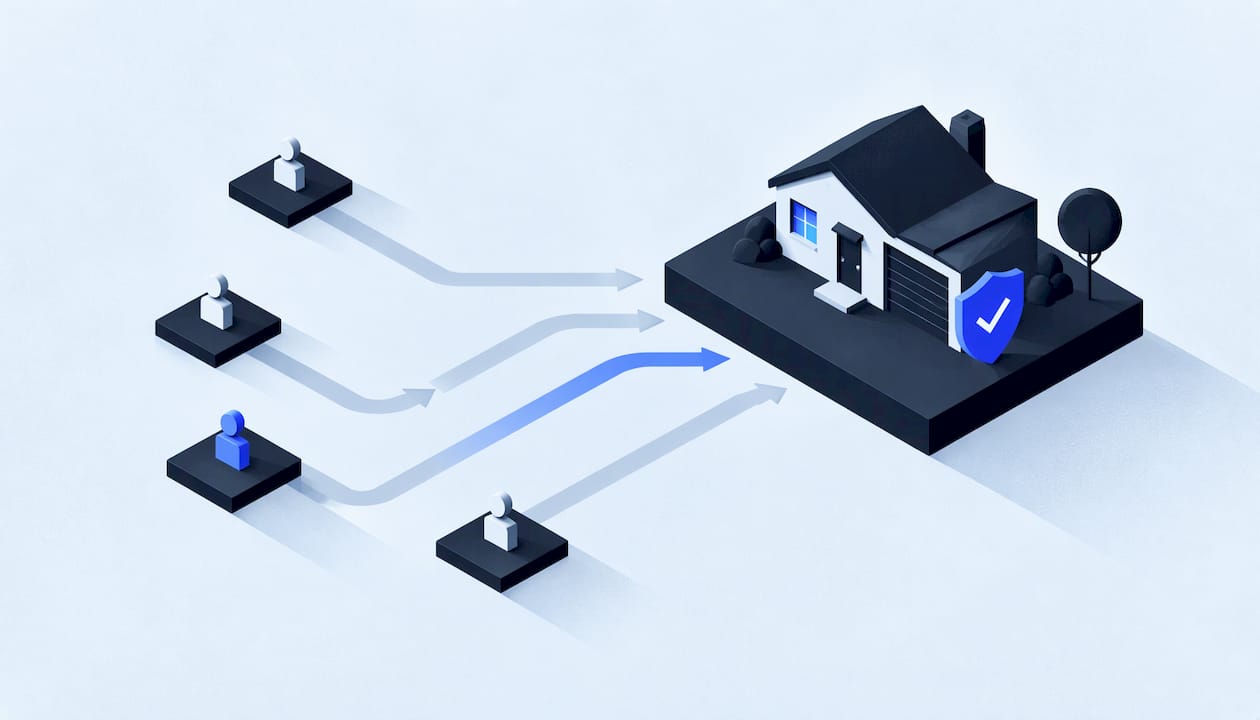
Most home service companies do not have a lead generation problem first. They have a lead handling problem. The phone rings during a job, the web form lands in an inbox nobody checks until evening, and a homeowner with a leaking pipe calls the next company on the list. Good home service lead generation has two halves: sources that bring in inquiries (local search, Local Services Ads, referrals, marketplaces) and a system that answers, qualifies, follows up and tracks every one of them. Spend on the first half only pays off when the second half works. That second half is what we build at Equinox Strategies for US service businesses.
TL;DR
- Lead sources fall into four groups: local search and your Google Business Profile, Local Services Ads, referrals and repeat customers, and paid marketplaces. Each one is only as good as your response to the lead it sends.
- Google's Local Services Ads charge when a qualified lead contacts you, and ranking depends partly on responsiveness, so a missed call costs you twice.
- Shared leads (sold to several contractors) and exclusive leads (sold to you alone) should be compared on cost per booked job, not cost per lead.
- Track the source of every call, form and message in one record. Without that, you cannot tell which channel earns its budget.
- Automated answering, qualification and follow-up keep leads from slipping away when your team is on a roof or under a sink.
Table of Contents
- The four places home service leads come from
- How Local Services Ads decide who gets the job
- Local search and AI search visibility
- Shared leads vs. exclusive leads
- Where leads actually get lost
- A response routine that books more jobs
- Tracking: know which source earns its budget
- Why fragmented tools hold growth back
- Our perspective
- What we build for service businesses
- FAQ
- Sources
The four places home service leads come from
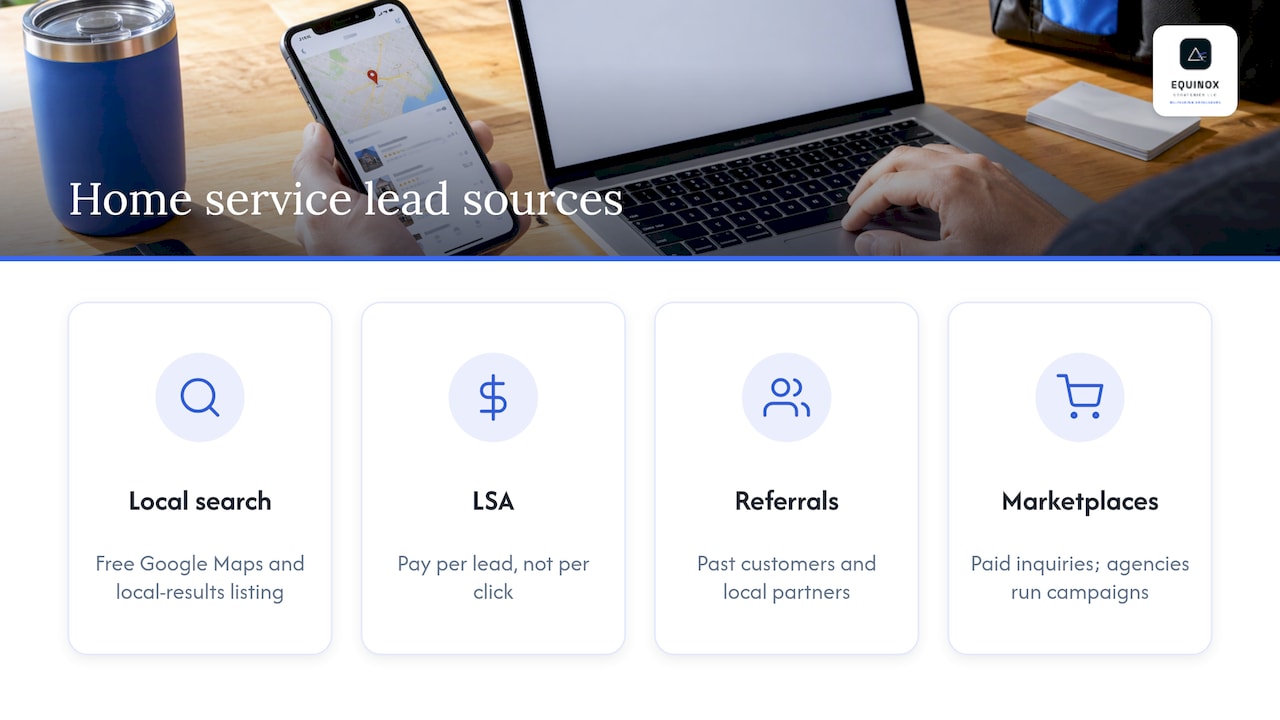
Whether you run an HVAC shop, a plumbing company, a roofing crew or a water damage restoration team, new work reaches you through four channels. Most healthy companies use two or three at once.
Local search and your Google Business Profile. This is the free listing that shows your company in Google Maps and local results. It brings homeowners who search "emergency plumber near me" and call straight from the listing. It rewards complete profiles, steady reviews and accurate hours and service areas.
Local Services Ads (LSA). These are the Google ads at the very top of results that show a company name, star rating and a "Google Guaranteed" or "Google Screened" badge. They are pay-per-lead rather than pay-per-click.
Referrals and repeat customers. Past customers, property managers, insurance adjusters, realtors and other trades. This channel is cheap, but it only works when you follow up and stay in touch, which most small teams do inconsistently.
Lead marketplaces and agencies. Platforms such as Angi, HomeAdvisor and Thumbtack sell inquiries, and agencies run campaigns for you. They can fill a calendar quickly, and they are the channel where tracking and response speed matter most, because you are paying for each inquiry.
How Local Services Ads decide who gets the job
If you take one channel seriously, make it LSA, because Google publishes how it works. According to Google's guidance on Local Services Ads (August 2025), ad visibility is driven by proximity, review score and review volume, responsiveness to leads, the quality of your Google Business Profile (services, hours, photos and badges such as License Verified or Google Screened), your bid mode and your budget. Advertisers pay only when a qualified lead contacts them by call, message or booking.
Two things follow from that.
First, you are billed for the lead whether or not anyone picks up. A call that goes to voicemail at 6:40 p.m. can still be a charged lead, and the homeowner has already dialed the next company.
Second, responsiveness is a ranking factor. Slow or missed replies can lower the visibility you are paying for. That makes your phone and messaging process part of your advertising, not a separate administrative matter. We wrote up the mechanics in how service businesses stop paying for missed Google Local Services leads.
A practical LSA checklist:
- Complete the business profile: every service you offer, accurate hours, service area, real job photos.
- Finish license and background verification so the badges appear.
- Ask every happy customer for a review, the same week the job closes.
- Set your hours to match when someone will truly answer.
- Review leads weekly: which were real jobs, which were wrong-service or out-of-area calls you can dispute.
Local search and AI search visibility
Beyond ads, the organic side is a long game: service pages for each trade and city you cover, a consistent name, address and phone number across directories, and a steady flow of reviews. Homeowners increasingly get answers from AI assistants as well as from search results, so the same clear, local, factual pages help in both places. If you want to go deeper on the tactics, the local SEO and AEO lessons cover search and AI-search visibility step by step.
Shared leads vs. exclusive leads
Marketplaces sell leads in two basic ways.
| Shared lead | Exclusive lead | |
|---|---|---|
| Who receives it | Several contractors at once | Only you |
| Typical price per lead | Lower | Higher |
| What the homeowner experiences | A flurry of calls, price shopping | One or two calls |
| What decides who wins | Mostly who calls first | Quality of your conversation and follow-up |
| Risk | Paying for a lead that three others already worked | Paying more for an inquiry that is still only a request for a quote |
The lower sticker price of a shared lead is misleading, because the number that matters is what you pay for each job you actually book. Here is a hypothetical example with round numbers, not market data:
- Shared lead at $50, and you book 1 job in 8: $400 per booked job.
- Exclusive lead at $90, and you book 1 job in 4: $360 per booked job.
The cheaper lead ended up costing more. Your own close rate decides which model suits you, and you only know your close rate if every lead is recorded and its outcome is tracked. Before buying from any source, check four things: whether the lead is shared, whether you can dispute or get credit for bad leads, whether the contact details come with the homeowner's consent to be contacted, and how quickly the lead reaches you.
Where leads actually get lost
The pattern is the same across trades. Leads rarely fail to arrive. They arrive and then stall:
- After-hours calls. Burst pipes, no-heat calls and storm damage do not wait for business hours. Restoration and emergency plumbing companies see the most urgent demand at the worst times.
- Calls during jobs. The owner is on a roof, the office manager is on another line, and the call rolls to voicemail.
- Web forms and messages. Inquiries from your website, Google messaging, Facebook and marketplaces land in four different places.
- The quote that goes quiet. An estimate goes out, nobody follows up, and the homeowner signs with whoever called back on day two.
- Duplicate and fragmented records. The same customer exists in the phone log, a spreadsheet, the scheduling app and somebody's texts.
The Lead Response Management study is often quoted for how steeply the odds of reaching a lead fall in the first minutes; the exact numbers matter less than the direction: the faster you reply, the more of the lead you keep. For an emergency service, the first company to answer a real person is frequently the one that gets the job.
A response routine that books more jobs
This is the routine we would put in front of any front desk team, whatever software it runs on.
Step 1: Answer every inbound call and message immediately
The goal is a real response within a minute or two, at any hour. A live person is ideal during business hours. After hours, and whenever the line is busy, an AI voice agent can answer, collect the problem, address and urgency, and book or hand off. We build AI voice and messaging agents for exactly this gap, so a call during a job does not become a lost lead.
Step 2: Qualify in the first conversation
Four questions sort most inquiries: what is the problem, where is the property, how urgent is it, and is the caller the decision maker. Add trade-specific questions: system age for HVAC, active water or not for restoration, roof type or insurance claim for roofing. Out-of-area and wrong-service inquiries get a polite redirect instead of a dispatcher's time. Qualification answers should be written into the customer record, not left in someone's memory.
Step 3: Book or schedule the next action
Every lead ends the first contact with a date: a booked appointment, an estimate visit or a scheduled callback. A lead with no next step is a lead that will be forgotten. Calendar, customer record and reminders should be the same system, so nobody retypes the details.
Step 4: Automate the follow-up
Estimates, unanswered calls and unbooked inquiries need a sequence: an immediate text confirming you received the request, a reminder before the visit, a nudge after the estimate, a later check-in. The sequence stops the moment the customer replies or books. Our follow-up automation build guide walks through the logic, and the service email templates give you wording for home and field service teams.
Step 5: Record the outcome
Won, lost, and why. Without the outcome, every report you build later is a guess.
Tracking: know which source earns its budget
The keyword "service lead tracking" really means one question: of the leads I paid for, which became revenue? Answering it takes three layers.
Call tracking. Give each channel its own tracking number, so a call from your LSA listing, your website and a truck wrap are distinguishable. See our call tracking setup guide for the steps.
Source attribution. Every form, message and call is tagged with its source and stored on the customer record. The lead source attribution walkthrough covers a practical setup, and if you run Google Ads, secure call tracking with Data Manager shows how to feed results back to your CRM (customer relationship management system) without exposing customer data.
Outcome reporting. Connect the lead to the job and invoice. Then these metrics become answerable:
| Metric | How to calculate | What it tells you |
|---|---|---|
| Cost per lead | Channel spend / leads received | What the inquiry costs |
| Answer rate | Leads answered live or within your target time / total leads | Whether you are wasting paid leads |
| Booking rate | Booked jobs / qualified leads | How well you convert conversations |
| Cost per booked job | Channel spend / booked jobs | The number to compare channels on |
| Average job value | Revenue / completed jobs | What a lead is worth to you |
| Follow-up conversion | Estimates won after follow-up / estimates sent | Whether follow-up pays |
Review these monthly by channel. Move budget toward the channels with the lowest cost per booked job, and fix the answer rate before you raise any ad budget.
Why fragmented tools hold growth back
A typical small service company ends up with a phone system, a website form plugin, a scheduling tool, a spreadsheet of estimates, a review request tool and a marketplace dashboard. Each does one job. None of them share a customer record. The cost is the manual copying between them, and the gaps where a lead falls through.
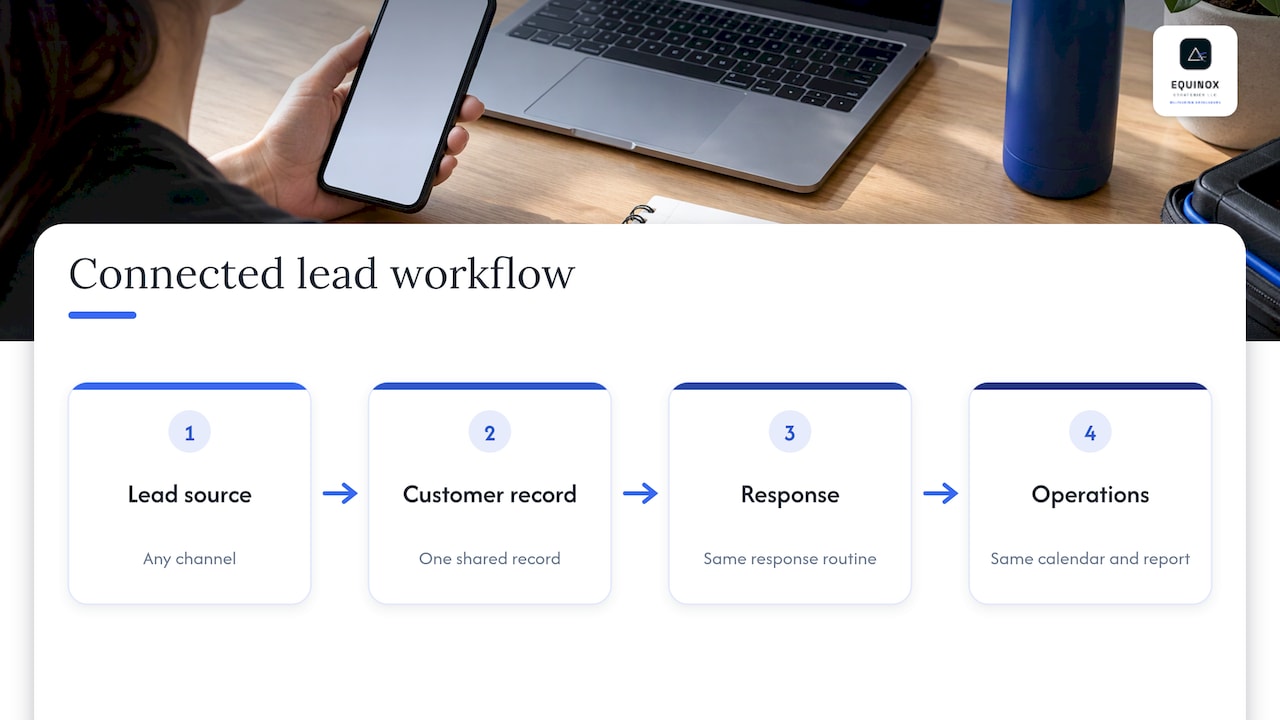
The fix is not another subscription. It is a connected setup in which a lead from any channel creates one customer record, triggers the same response routine, lands on the same calendar and feeds the same report. When standard platforms cannot do that for how your business actually runs, custom software built from a clear brief can. Our guide on choosing workflow automation services explains what to ask for.
Our perspective
We start every engagement from the same observation: businesses already pay for leads, through ads, marketplaces and reputation built over years, and they lose a share of them in the first minutes because nobody could pick up.
That is why we do not sell lead generation as a separate thing from lead handling. A new source with no answering, qualification, follow-up and tracking behind it simply moves the leak to a bigger bucket.
Our builds are scoped and documented before anything is switched on. We work with least-privilege access, written data maps, explicit consent flows and rollback plans, and a single accountable technical lead owns the work. A phone line that books jobs touches customer names, addresses and payment conversations, so security belongs in the design, not in an afterthought.
We would rather you can check what we built, in the code and in the process, than take a promise on trust.
Felix
What we build for service businesses
We work with US service businesses such as HVAC, plumbing, roofing, water damage restoration and general contractors. The offer covers custom lead generation systems, AI voice and messaging agents for answering and qualifying inquiries, done-for-you automations for follow-up, an operating layer that unifies customer records, calendars and reporting, and custom software when an off-the-shelf platform does not fit. Projects are scoped and documented, and optional ongoing monthly support is available.
If you are already paying for leads and want to see where they are slipping away, start on our lead systems page, or look at the full service overview.

FAQ
How do I get more home service leads without raising my ad budget?
Start by answering the leads you already pay for. Fix after-hours and busy-line coverage, add automated follow-up for unbooked estimates, and complete your Google Business Profile so you rank higher for responsiveness and profile quality. Then add referral and review requests after every completed job.
Are Local Services Ads worth it for HVAC, plumbing, roofing and restoration?
They can be, because you pay when a qualified lead contacts you rather than for every click, and Google weighs responsiveness in visibility. Whether they pay off for you depends on how many leads you answer and book, so measure cost per booked job.
Should I buy shared or exclusive leads?
Compare them on cost per booked job using your own booking rates. Exclusive leads cost more per inquiry but are often worked by fewer competitors, while shared leads reward fast first contact. Ask about dispute and credit terms for bad leads before buying either.
What is the simplest way to track home service leads?
Give each channel its own tracking number, tag every form and message with its source, and store all of it on one customer record that also holds the outcome. That single record lets you see which channel produced booked and paid jobs.
Sources
- How to grow your business with Local Services Ads, Google
- Speed to lead statistics and the Lead Response Management study
- Local SEO + AEO + GEO Academy