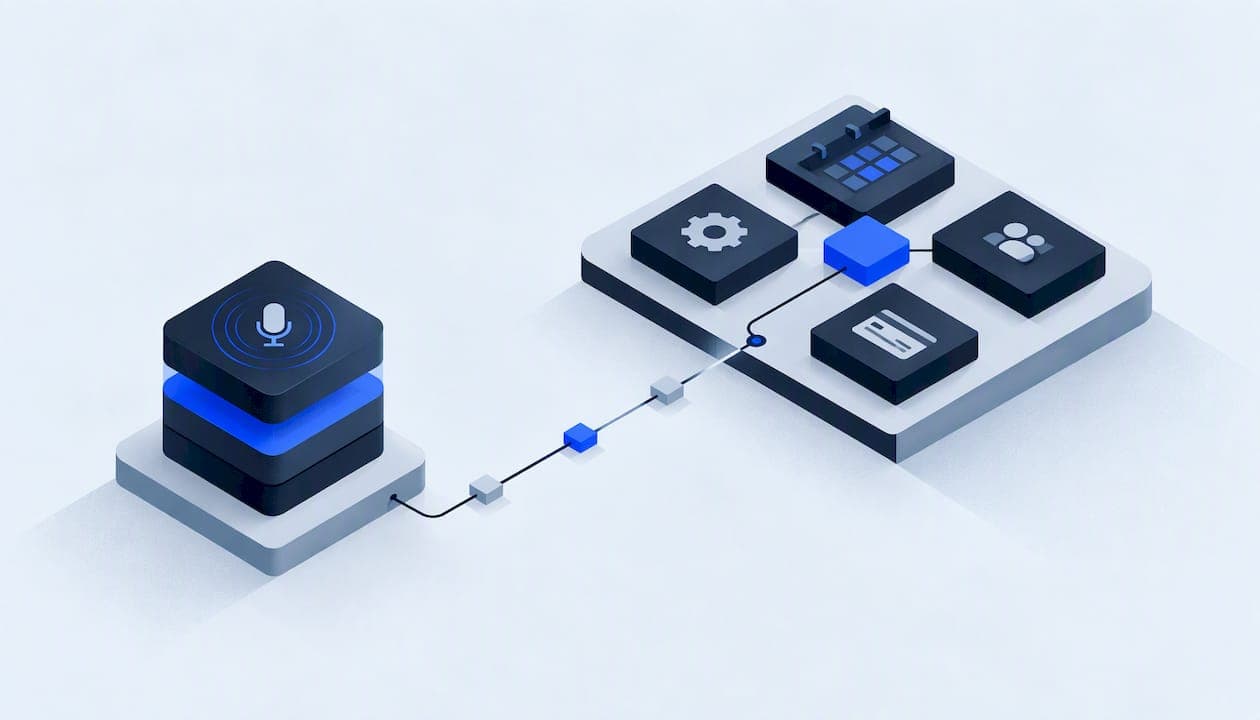
An AI voice agent is software that answers or places phone calls, understands what the caller says, and acts on it: it books the job, qualifies the lead, updates your records and hands off to a person when it should. For an HVAC, plumbing, roofing or water damage company, the value is simple. The call gets picked up at 2 a.m., on the third ring during a rush, or while your front desk is on another line. The risk is just as simple: an agent that talks in your company's name without limits, consent or oversight.
This guide covers what these agents do, what they cost, the US legal rules you need to know before dialing, and the security questions to ask before anyone connects one to your phone line.
TL;DR
- An AI phone agent is worth it when missed calls and slow follow-up cost you jobs. It only works if it is wired into your calendar, CRM and dispatch, not bolted on as a standalone answering tool.
- Per-minute quotes are a fraction of the real bill. Research on voice AI build and run costs puts off-the-shelf platforms at roughly $5,000 to $70,000 a year once transcription, language model, voice, telephony and compliance add-ons are counted.
- Inbound answering and outbound calling are different legal problems. In the US, AI-generated voices fall under the TCPA, and consent must exist before the call.
- Security certifications cover the servers, not what the agent says. You need guardrails in the conversation itself, plus logs, access limits and a rollback plan.
- Unapproved "shadow" agents are a liability. Every agent should have an owner, a written scope and a record.
Table of Contents
- What an AI voice agent does on a service call
- Which names people use, and what they mean
- What it really costs
- Inbound is easy. Outbound needs consent first
- Security: the layer buyers forget
- Build or buy: a decision framework
- Our perspective
- Where we fit
- A short launch checklist
- FAQ
- Sources
What an AI voice agent does on a service call
Older phone systems made callers press 1 for service and 2 for billing. A voice agent holds a conversation. It hears "my water heater is leaking into the garage," asks the follow-up questions you would ask, and decides what happens next.
For a service business, a useful agent usually does five things:
- Answers every call, including after hours, overflow and weekends.
- Qualifies the inquiry. Is it an emergency? What is the address? Is it in your service area? Is the caller the owner or a tenant?
- Books or routes. It puts a job on the calendar, or transfers a live call to a dispatcher or on-call tech for the cases that need a person.
- Writes everything down. The call summary, caller details and next step land in the same customer record your office uses.
- Follows up. A text confirming the appointment, a reminder, or a nudge for the quote that went quiet.
The fifth point is where most deployments stall. An agent that answers beautifully but leaves the lead in a separate inbox just moves the pile. If you are weighing the after-hours case in particular, our piece on after-hours answering for small businesses goes through why voicemail loses so many callers.
Which names people use, and what they mean
The market uses several labels for overlapping things. Knowing the difference keeps you from buying the wrong product.
| Term | What it usually means | Best fit |
|---|---|---|
| AI call answering / automated call answering | Picks up inbound calls, takes a message or answers basic questions | Businesses whose main problem is missed calls |
| AI phone receptionist / virtual AI receptionist | Answers, screens, books and transfers, in the role of a front desk | Small teams with one overloaded office |
| AI voice agent / AI phone agent | The broader category, including outbound calls and multi-step workflows | Firms that want lead response, reactivation and follow-up |
| Voice AI platform | The toolkit a developer or integrator builds agents on | Teams with technical capacity, or a partner who has it |
A receptionist-style product is often enough to stop the bleeding. A full agent pays off when calls feed a bigger system: scheduling, estimates, invoicing, review requests. If cost is your first question, we break down AI receptionist pricing for small businesses separately.
What it really costs
The price on a landing page is almost never the price you pay. A 2026 analysis of voice AI development costs describes the range this way:
| Approach | Typical upfront cost |
|---|---|
| Off-the-shelf platform | $0 to $500 |
| Cloud-based custom build | $25,000 to $150,000 |
| Fully custom build | $50,000 to $300,000 or more |
The same source puts annual total cost of ownership for production-grade, off-the-shelf deployments between $5,000 and $70,000, and notes that HIPAA-grade compliance add-ons commonly run about $1,000 a month. Those figures come from vendor-side research aimed at larger deployments, so treat them as outer bounds for a contractor with a handful of trucks, not a quote.
The lesson is the "platform trap". A low per-minute rate leaves out transcription, language model usage, voice synthesis, telephony charges and compliance extras. Before you sign anything, ask for a modeled monthly bill at your actual call volume, including your busiest week after a storm.
A useful sanity check: count how many calls you miss now, multiply by your average ticket and your close rate, and compare that to a realistic annual cost. If the gap is small, a simpler answering service may be the honest answer.
Inbound is easy. Outbound needs consent first
Answering the phone when a customer calls you carries few legal complications. Calling people with an AI voice is different.
In February 2024 the FCC ruled that AI-generated voices are "artificial" under the TCPA, so the same consent rules that govern robocalls apply. In practice, consent has to exist before the call begins: you cannot gather it mid-call, and opening the call with "this is an automated assistant" adds transparency but does not replace prior express written consent that names the seller.
The rules on revocation and one-to-one consent have shifted over recent rulings, and the details change. The Kaigen Labs overview of TCPA rules for AI voice agents tracks which parts are currently in force. Have your attorney confirm the current position before any outbound campaign, especially if you call purchased lead lists or old estimate requests.
Practical rules we apply when scoping outbound work:
- Store the consent record (when, where, what wording) with the contact, so you can prove it.
- Honor opt-outs immediately and across every channel.
- Start with a small pilot to people who have clearly asked to hear from you, such as a web form submitter requesting a quote.
- Keep a written pilot checklist. Ours is in AI outbound calling pilot checklist for US operations.
Security: the layer buyers forget
Most vendor pages talk about encryption and certifications. Those matter, but they answer only half the question.
Infrastructure security is not conversation security
SOC 2 or HIPAA compliance describes how the servers are run. It does not stop an agent from making things up on a live call: promising a discount, quoting a price you never set, or confirming a warranty you do not offer. That control has to be built into the conversation design: what the agent may say, what it must refuse, and when it hands off.
Callers can attack the agent
Security researchers point out that access controls alone are not enough. Callers can try to talk an agent out of its rules or coax out data it should not share. The layered answer is automated policy enforcement, encrypted streams (TLS 1.2 or higher) and immutable audit logs that record each decision the agent made.

For service businesses, the common version of this is identity. Someone calls claiming to be a homeowner and asks to change an appointment address, or asks for a technician's schedule. We cover the defenses in caller identity verification for service businesses, and spoofed numbers are a related issue, covered in caller ID reputation checks.
Shadow voice AI
The most common risk in smaller firms is not a hacker. It is a well-meaning office manager who signs up for a tool and forwards the main line to it. The Dilr team defines shadow voice AI as a voice agent deployed without approval, oversight or a record, and cites IBM figures indicating that high levels of shadow AI add roughly $670,000 to the average cost of a data breach. That is an enterprise-scale number, but the habit it describes is the same at any size: nobody knows what the agent was told, what it stores, or who can change it.
The fix is boring and effective. Name an owner, write down what data the agent sees and where it goes, and keep a record of every agent that touches customers. If you want to audit what your existing tools do before adding another, a tracker for how your business shows up in AI-driven search can show how customers are finding you at all, which tells you where calls are really coming from.
Build or buy: a decision framework
There is no single right answer. Use these criteria.
Buy a ready-made tool when:
- Your calls are fairly standard and your scheduling software already has a supported integration.
- You want to be live in days and can accept the platform's limits.
- You have someone in-house who will monitor transcripts weekly.
Commission a custom build when:
- Your dispatch rules are particular: service zones, emergency tiers, crew skills, insurance-driven restoration workflows.
- Your systems do not talk to each other, so the agent would create one more silo.
- You need control over where data is stored, who can read it and how to undo a bad change.
- You also need other pieces, such as automated email follow-up. Infrastructure like mailboxes built for AI agents exists for that purpose, but someone still has to connect it to your records and approvals.
Whichever way you go, insist on four things in writing: the scope, a data map, a monitoring plan and a way back. Our 30-day monitoring plan for AI agents shows what to watch after launch, and automation runbooks cover who does what when something breaks.
Our perspective
We build these systems for US service businesses, and our view is shaped by one pattern: the voice is rarely the hard part. Getting a natural-sounding agent to say "I can get a technician out this afternoon" takes an afternoon. Making that sentence true is the project. It means the agent reads the real calendar, knows which crews cover which zip codes, writes the job into the same record your office uses, and tells a human when it is unsure.

That is why we scope and document every build before we write anything. We work with least-privilege access, written data maps, explicit consent flows and rollback plans, and a single accountable technical lead stays on the work from start to finish. We do not publish case studies or promise percentages. We would rather show you the architecture, the code and the process so you can check it yourself.
Our advice for a first project is modest. Pick one call type, such as after-hours emergency intake. Run the agent beside your people for a few weeks, read the transcripts, and expand only when the logs show it is behaving. An agent you trust slowly is worth more than one you doubt quickly.
— Felix
Where we fit
If your problem is missed calls and slow lead response, or if your tools are scattered across a phone system, a calendar and a spreadsheet, that is the work we do. We design lead generation systems, AI voice and messaging agents, done-for-you automations and custom software for US service businesses, built around the systems you already run. You can see the full range on the Equinox Strategies site. We do not publish prices, because scope drives them, so the first step is a conversation about your call flow.
A short launch checklist
- Measure your current missed-call and after-hours volume for two weeks.
- Choose one use case and write down what the agent may and may not say.
- Map every system the agent reads or writes, and the data it holds.
- Decide the handoff rules: emergencies, angry callers, anything involving price negotiation or liability.
- Confirm consent and recording-disclosure wording with your attorney, especially for outbound calls and for states with two-party recording rules.
- Run a supervised pilot, review transcripts daily at first, and set a rollback trigger in advance.
- Review monthly: costs against forecast, handoff rate, and complaints.
FAQ
Will callers know they are talking to an AI?
Many will within a sentence or two, and they should be told. For inbound calls, a short disclosure at the start builds trust and reduces awkward moments. For outbound calls, disclosure does not replace the prior written consent the TCPA requires.
Can an AI voice agent replace my front desk?
It can take over the repetitive part: answering, qualifying and booking. It should not own anything that needs judgment, such as a dispute over a bill or a safety situation. Most firms get the best results when the agent clears the routine calls and your staff handles the conversations that need them.
Is a cheap per-minute plan a good deal?
Only if the full bill stays low. Transcription, language model usage, voice, telephony and compliance add-ons can multiply the headline rate, as cost research on voice AI documents. Ask for a projected monthly total at your real call volume.
Do I need HIPAA or SOC 2 for a contractor?
Usually HIPAA applies only if you handle protected health information, which is uncommon for HVAC or roofing. Security still matters: encryption, limited access and logs are reasonable for any business. Ask your attorney if your work touches healthcare facilities or regulated data.
What should I do first?
Track your missed calls for two weeks and pick one call type to automate. A small, supervised pilot tells you more than any demo will.
Sources
- Voice AI Development Costs in 2026, Master of Code
- FCC Rules AI-Generated Voices Are "Artificial" Under the TCPA, Wilson Sonsini
- TCPA Compliance for AI Voice Agents, Teams Plus
- TCPA Compliance for AI Voice Agents, Kaigen Labs
- AI Voice Agent Security: What Enterprise Buyers Should Ask, OnDial
- AI voice agent compliance, NewVoices
- Shadow voice AI: governing agents nobody signed off, Dilr