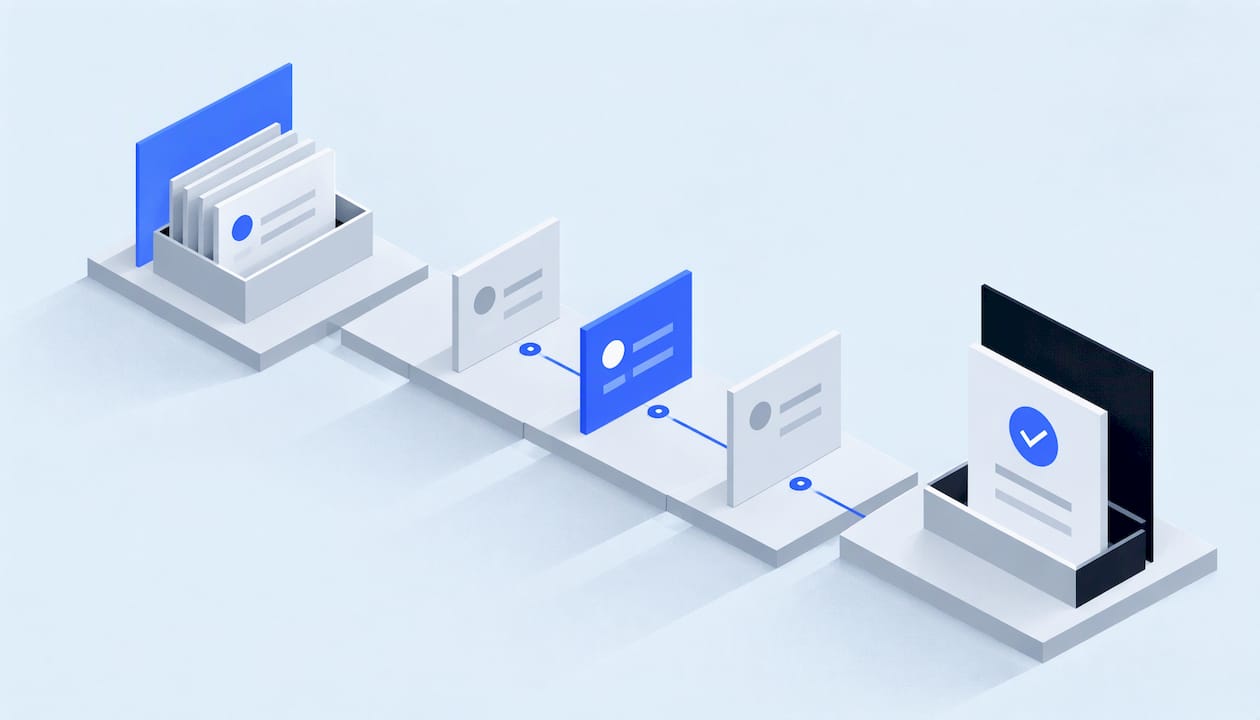
A good customer inquiry response does three things: it arrives quickly, it proves someone read the message, and it moves the customer one clear step toward a booked job. For a service business, the third part is the one that gets skipped. Most inquiries arrive while a crew is on a roof, under a sink or in a flooded basement, so the reply depends on whoever happens to look at the phone. The fix is not working harder at the inbox. It is a defined process: every inquiry is captured, has one owner, gets a useful first reply and has a next step on the calendar. Our own approach at Equinox Strategies is to build exactly that process into the systems service businesses already run on.
This guide is written for HVAC, plumbing, roofing, restoration and general contracting owners, office managers and front desk teams. It covers what a strong reply contains, how fast to respond, how to keep replies consistent when volume spikes, and how to handle difficult messages.
TL;DR
- A strong reply answers every question asked, mentions the customer's specific situation and asks for only the one piece of information needed next.
- Speed matters most when it is tied to quality: an instant acknowledgment buys time, but a human or well-built agent reply is what keeps the lead.
- Give every inquiry one named owner, a status and a next action. A shared inbox makes messages visible, not handled.
- Templates are starting points. Edit them to the customer's actual situation, and never send one to an upset customer unchanged.
- Automate capture, acknowledgment, routing and follow-up reminders so the front desk spends its time on conversations, not chasing.
Table of Contents
- What a good response actually accomplishes
- How fast is fast enough
- A response sequence from receipt to follow-up
- Keep the record minimum but complete
- Writing replies that sound like a person
- Handling complaints and difficult inquiries
- When volume spikes
- Putting this to work in your business
- FAQ
- Sources
What a good response actually accomplishes
An inquiry is any first message from a person who wants something from you: a form fill, a missed call with a voicemail, a text, a review-site message or an email asking for a quote. The job of your answer is not to look busy. It is to resolve the question and set up the next step.
TechTarget's 2026 guide on customer service emails makes the point that a complete answer reads the message carefully, answers each question the customer asked and anticipates the next question they did not know to ask. For a service business that translates into practical details:
- A homeowner writes, "My AC is blowing warm air, how much for a diagnostic?" A weak reply says, "Thanks for contacting us, we will be in touch." A strong one confirms you service their area, states how the diagnostic visit works, and asks one thing: "Is the unit running at all, or has it shut off completely?"
- A property manager asks about water damage in a unit. The strong reply treats urgency as the main subject: it says what happens next and who is calling, and asks for the address and whether water is still actively coming in.
One writer on the topic, Rasel Hossain, in a framework for service-business lead response, puts the difference well. The first human contact should show that someone read the inquiry, name the specific service or question, answer what can be answered and ask for the smallest amount of information needed to continue. A line like "Please share details" hands the work back to the customer. A specific question moves things along.
The four parts of a first reply
- Proof it was read. Name the service, the problem or the location they mentioned.
- A real answer. Give whatever can be answered now: service area, how a visit works, what happens next.
- One question. Ask for the single detail you need, not a form's worth of them.
- A next step with timing. "I can have a technician out between 1 and 3 p.m. tomorrow. Does that work?" beats "let us know."
How fast is fast enough
There is no single legal or universal deadline for replying to an inquiry. What exists is customer expectation, and expectation in home services is shaped by urgency. Someone with a burst pipe is not comparing three quotes over a week. They call or message several companies and book the first one that engages.
TechTarget's guide recommends acknowledging every customer email, publishing your expected response times and using an auto-reply that confirms receipt, sets a specific expectation and points to self-service resources. That is a sound baseline for the written channel.
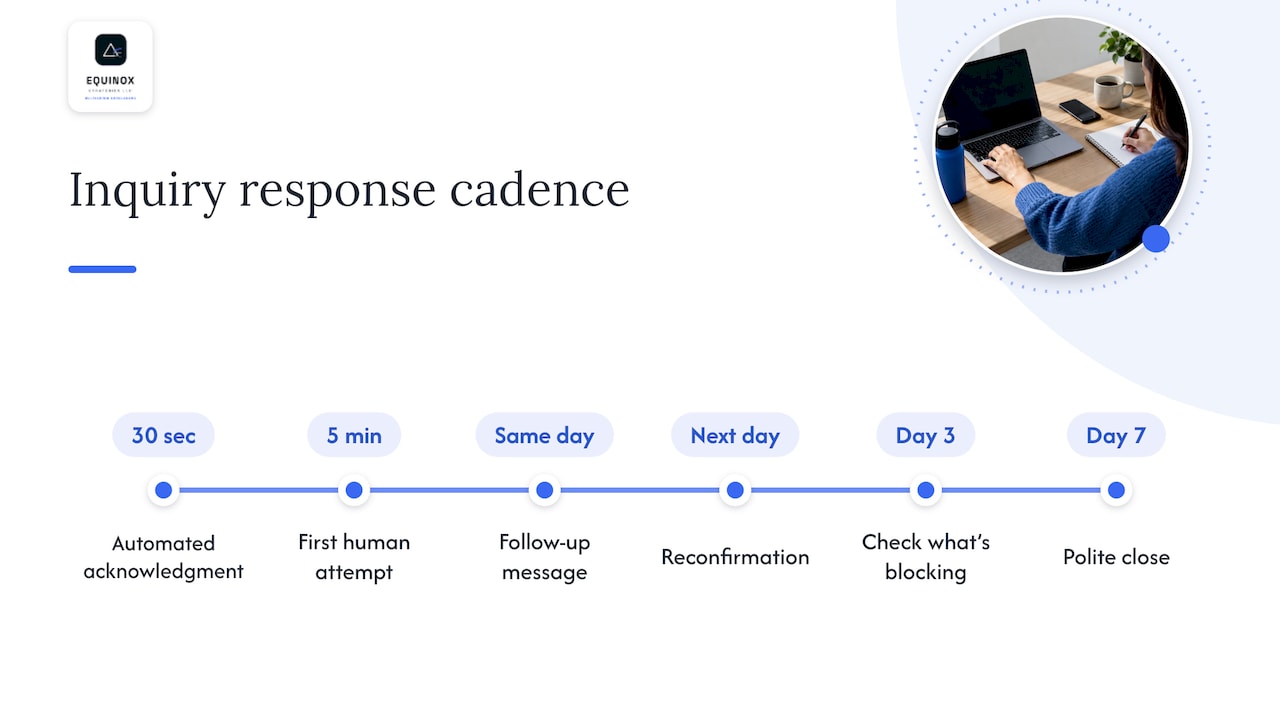
For lead-driven businesses, the FIRST-5 framework mentioned above offers a practical target sequence for business-hours inquiries: an automated acknowledgment within 30 seconds, a first human attempt within five minutes, then a follow-up cadence of a same-day message, a next-business-day reconfirmation, a day-three check on what is blocking the customer and a polite close around day seven. It adjusts timing by service type and consent, and it honors opt-outs immediately. Treat those numbers as a working target to tune to your trade, not a regulation.
Set targets by urgency, not by channel
A useful way to organize this is three tiers:
| Inquiry type | Examples | Working target for first meaningful reply |
|---|---|---|
| Emergency | Active leak, no heat in winter, storm damage, flooding | Minutes, by phone or text, any hour you offer emergency service |
| Ready to book | Quote requests, replacement estimates, inspection requests | Within minutes during business hours |
| Research | Pricing questions, "do you service my area" | Same business day |
The tiers are our suggested structure, and your own numbers should reflect your crew capacity. The point is that the target is written down, so everyone knows what "on time" means.
A response sequence from receipt to follow-up
Here is the routine, step by step, with the places it usually breaks.
Step 1: Capture every inquiry in one place
Phone calls, web forms, texts, emails, ad leads and review-site messages should all land in one record system. The usual failure is a lead that lives only in someone's personal phone or a voicemail box. If it is not captured, it cannot be owned.
This is where call data matters too. If you buy leads through ads, you need to know which calls came from which campaign and what became of them. Tracking calls to improve business performance is the habit that lets you record each inquiry's source, status, owner and outcome. Our own guide to secure Google Ads call tracking into a CRM walks through connecting that data to your records.
Step 2: Acknowledge immediately
An automatic confirmation tells the customer the message arrived and when to expect a person. It should state a concrete expectation, such as "A team member will text you within 15 minutes during business hours." One caution from process specialists at Oprendia: an automated acknowledgment should not be counted as a meaningful response unless it is explicitly appropriate. It starts the clock on the real reply. It does not stop it.
Step 3: Assign one owner
This is the step most small teams get wrong. When three people can see a message, each assumes another will answer. Oprendia's view is that visibility is not ownership: a shared inbox shows messages to several employees without deciding who must act. A reliable process names one accountable person for each active inquiry and has a rule for reassigning or escalating if that person is on a job site or out sick.
Routing rules can do this automatically. Our build guide on round-robin lead assignment shows how to spread new inquiries across a team and test the logic before it goes live.
Step 4: Send the first meaningful reply
This is the four-part reply described above. It can come from a person, or from an AI voice or messaging agent that answers, qualifies the inquiry and hands it to your team with the details already collected. Where it goes wrong: replies that ask five questions at once, or that quote a price range before knowing the job type.
Step 5: Book or schedule the next action
Every inquiry ends step five in one of two states: a scheduled appointment or a dated follow-up. Never "waiting to hear back" without a date. If the customer is ready, offer times in the reply itself. See how automated appointment scheduling fits into this for service teams.
Step 6: Follow up on a cadence
Most inquiries do not convert on the first touch. A written cadence keeps follow-up consistent whether the office is calm or buried. Our guide to follow-up automation for service businesses covers how to build one. Respect consent: if someone says stop, stop immediately and record it.
Step 7: Record the outcome
Booked, lost, not a fit, no answer. Without outcomes you cannot tell which sources and which replies work.
Keep the record minimum but complete
Oprendia lists seven things that should be true for every inquiry: it is captured in the tracking system, it has a named owner, it has a current status, an appropriate first response has gone out, its communication history is accessible, it has a next action with timing, and its outcome is recorded.
A minimum useful record to meet that standard has six fields:
- The inquiry itself, in the customer's words
- The source (phone, form, ad, referral)
- The owner
- The status
- The latest meaningful interaction
- The next action and its due date
The test is simple: could a colleague pick up the file tomorrow without reconstructing the story from three inboxes and a sticky note? If yes, the record works.
Writing replies that sound like a person
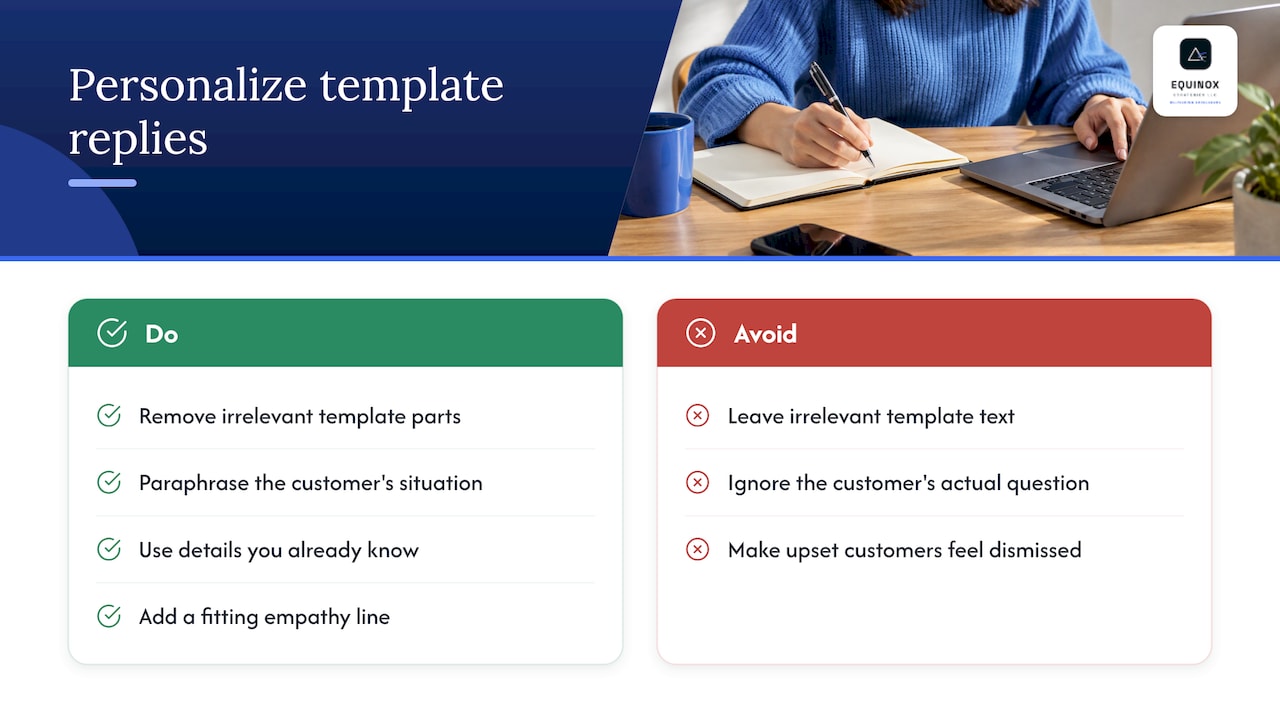
Templates save time and keep tone consistent, but they only work as starting points. TechTarget advises removing irrelevant parts, paraphrasing the customer's specific situation, using details you already know and adding an empathy line that fits. It also warns against a template that fails to answer the actual question or that makes an upset customer feel dismissed.
Here is a short example for a plumbing company:
Hi Maria, thanks for reaching out about the water heater that is leaking at the base. We service your zip code, and a technician can inspect it tomorrow between 8 and 10 a.m. Can you tell me whether you have shut off the water supply to the unit? If not, the valve on the cold line above it is the one to close.
It names the problem, confirms service, gives a time and asks one question. For a larger library, see our service email templates for home and field teams.
Phrases that help and phrases that hurt
Phrases that help are specific and committed: "I have your request for a roof inspection at the Elm Street address," "I will call you by 3 p.m.," "Here is what happens next." Phrases that hurt are vague or defensive: "per my last email," "as you should know," "we will get back to you," or "unfortunately, that is our policy" with no alternative offered. Replace the last with what you can do.
Handling complaints and difficult inquiries
A complaint is an inquiry with emotion attached, so the same structure applies with a different order. Acknowledge the problem first, in plain words, without defensiveness. State what you will do and when. Then ask for what you need to do it, such as photos, the job number or the best number to call.
Three habits help in service work:
- Move to a phone call fast. Written back-and-forth escalates; a call from a person with authority de-escalates.
- Never send an unedited template. An upset customer reads a canned line as being dismissed.
- Own the follow-through. Name who will call and when, then record the resolution.
Once a problem is fixed, a review request is a natural next step. Our guide to compliant review request automation shows how to ask in a way that respects consent rules.
When volume spikes
Storm season, a heat wave or a cold snap sends inquiries up several times over in a day. This is when the manual system fails: the front desk is on the phone, new calls go to voicemail and web forms sit unread. The answer is a process that does not depend on someone being free. Capture and acknowledgment happen automatically, routing assigns an owner, and urgent inquiries are flagged. We cover the phone side in detail in high call volume and how service businesses stop losing leads.
If you are comparing tools to manage the feedback and inquiry flow, a roundup of customer feedback management software is a place to start your list of requirements.
Our view: the inbox is not the problem
Service businesses rarely lose jobs because the team writes poor emails. They lose them because an inquiry arrives at a bad moment and nothing in the system catches it. A voicemail at 4:45 p.m., a form fill during a job, a text to an old number: each one is a customer who is still shopping.
That is why we build the response process as one connected system instead of a pile of separate tools. Every project is scoped and documented, with written data maps, least-privilege access, explicit consent flows and rollback plans, and one accountable technical lead. The voice answering, inquiry qualification, automated follow-up and unified customer records, calendars and reporting are meant to work together, so no lead is missed and follow-ups are consistently managed.
The test of any inquiry process is simple. Pick a random lead from last week and ask: who owned it, what was sent, what was the next step and what happened? If you can answer in under a minute, the system works. If not, the gap is in the process, and that is fixable.
Felix
Putting this to work in your business
If your front desk is overwhelmed, or leads still slip through after hours, the quickest gain is to connect the pieces: capture, voice and messaging answering, qualification, follow-up and a single customer record. We build lead generation systems, AI voice and messaging agents, done-for-you automations and custom software for US service businesses, with ongoing support available. You can see the full list on our services page and how a project runs on our process overview.

Where standard platforms cannot match how your operation works, we also build custom software from your brief. Start from the Equinox Strategies site and tell us where inquiries are getting lost today.
FAQ
How do you respond to a customer inquiry?
Read the whole message, then reply with proof that you read it, an answer to what was asked, one question that moves things forward and a next step with a time. Keep it short and specific. Record the inquiry, its owner and the next action so it cannot get lost.
How quickly should I respond to a customer inquiry?
As quickly as the urgency demands. A sensible working target is an automatic acknowledgment within seconds and a first human or agent reply within minutes during business hours, as in the FIRST-5 framework. Publish your expected response times so customers know what to expect.
Is an auto-reply enough?
No. An auto-reply confirms receipt and sets expectations, which is useful, but it is not a meaningful response. The customer still needs a reply that addresses their situation and proposes a next step.
Can I use templates for every reply?
Use them as a base, not a finished message. Edit each one to the customer's specific situation and add a fitting empathy line. For complaints, write a personal reply or call.
Who should own an inquiry when several people can see it?
One named person. Add a rule for reassignment or escalation when that person is unavailable, so the inquiry never sits with nobody acting on it.
Sources
- 15 customer service email templates and tips, TechTarget
- Five-Minute Lead Response System for Service Businesses
- How to Establish a Reliable Enquiry Management Process, Oprendia