
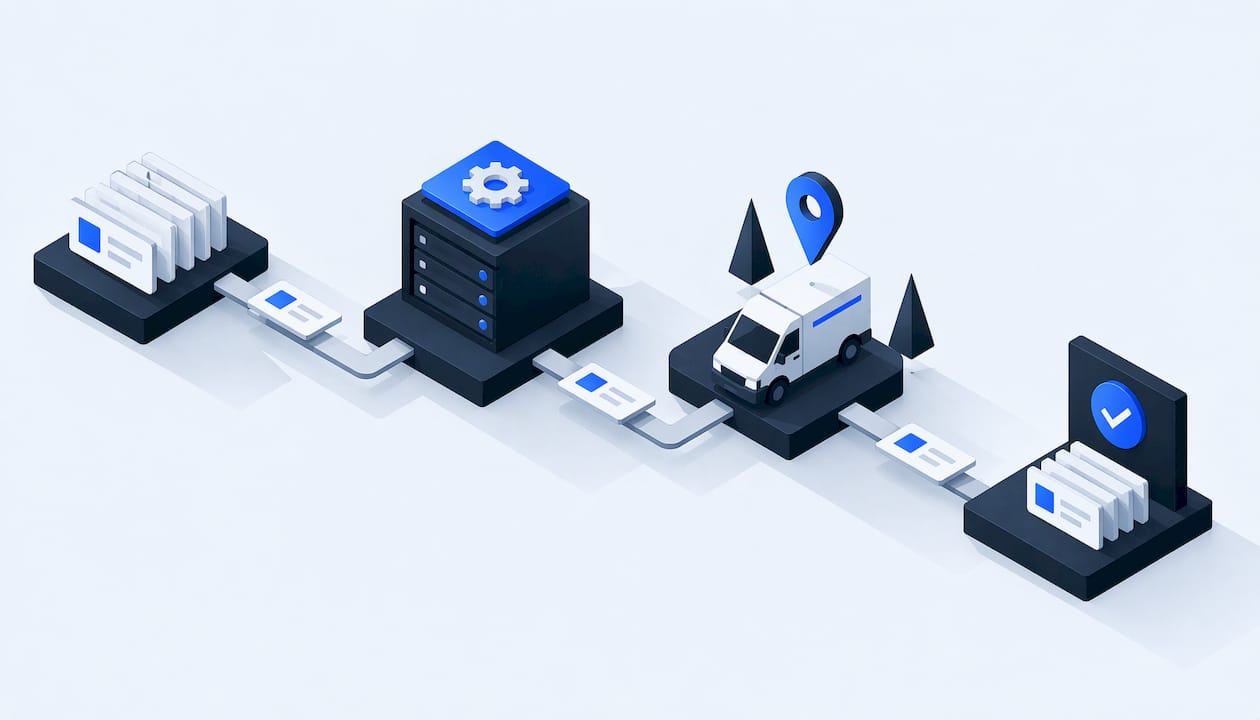
Service request management is the routine that takes a customer's call, form, text or email and carries it, without loss, to a booked job and a closed ticket. For an HVAC, plumbing, roofing or restoration company, the whole discipline comes down to four things: every request is captured in one place, someone owns it, the customer hears back fast, and nothing sits unanswered. We build that system for US service businesses, and this guide walks through the workflow so you can see where requests leak and what fixes each leak.
Most pages ranking for this term are written for corporate IT help desks. The ideas carry over well to a service company, but the examples (password resets, laptop access) do not. Here they are translated into the work you actually handle: the burst pipe at 9 p.m., the roof quote request from a web form, the AC tune-up reminder.
TL;DR
- A service request is a customer asking for a defined service. Managing it means standardizing intake, ownership, status updates and closure, so no request depends on one person's memory.
- The core workflow has seven steps: submit, validate, categorize and route, approve if needed, fulfill, verify, close.
- Requests arrive across several channels. Capture all of them in one trackable record, or some will be missed.
- Speed of first response and consistent follow-up are where service businesses win or lose the job.
- Start small: audit your channels, document your most common request types, assign owners and measure response time.
Table of Contents
- What service request management means in a service business
- Why a structured process matters
- The service request workflow, step by step
- Prioritizing, assigning and tracking
- Communication: where service businesses lose the job
- Choosing tools without overbuying
- Starting small: a practical rollout
- How we handle this for service businesses
- Our perspective
- FAQ
- Sources
What service request management means in a service business
The term comes from IT service management. ServiceNow describes a service request as a formal request from an employee, customer or vendor to start a predefined, agreed service action. Atlassian frames the process as a repeatable workflow for routine requests, from submission through completion.
Translate that to your trade. A request is any inbound ask for something you already know how to deliver: a diagnostic visit, a quote, a water extraction call, a maintenance plan renewal, a reschedule. The word "predefined" matters. You have standard services, standard information you need to collect, and standard next steps. That is what makes the work manageable as a process rather than a string of improvised phone calls.
Service requests versus incidents
IT teams separate requests from incidents. According to the ITIL practice guidance from itil.org.uk, requests are routine, planned and user-initiated, while incidents are unplanned interruptions. The same split helps in the field:
| Type | Field service example | Handling |
|---|---|---|
| Service request | Quote for a roof replacement, annual furnace tune-up, appointment change | Standard intake, scheduled fulfillment |
| Urgent or incident-style call | Active leak, no heat in winter, flooding | Immediate triage, on-call dispatch |
Both start with the same intake. They differ in priority and speed. Your system needs a way to spot the urgent ones in seconds and push them to your on-call technician. If you have not defined who that is, our guide to on-call rotation setup for service businesses covers it, and the incident response automation playbook covers what happens when an urgent job goes wrong.
Why a structured process matters
Without structure, a request lives wherever it landed: a voicemail box, a shared inbox, a text on the owner's phone, a sticky note at the front desk. Three problems follow.
No one owns it. If two people saw it, each assumes the other replied.
No one can see its status. A structured process makes ownership, status and expectations visible, which ServiceNow lists among the main benefits, along with handling recurring work consistently.
Every request costs more effort than it should. When the same questions are asked by hand on every call, the front desk spends its day re-collecting address, issue and availability.
Formal intake is also a sign of maturity. In an Atlassian survey of teams, formal request-intake processes were reported by 39% of low-maturity teams, 51% of medium-maturity teams and 65% of high-maturity teams. That survey covers internal support teams, not contractors, but the pattern is clear: the better-run the operation, the more likely requests enter through a defined door.
For a service company the cost is direct. A missed request is not a stale ticket, it is a homeowner who called the next company on the search results page.

The service request workflow, step by step
Atlassian's process guide sets out submission, validation, categorization and routing, approval where needed, fulfillment, verification and closure. Here is each step with what it takes in a field business and where it usually goes wrong.
1. Submission: capture it however it arrives
Customers reach you by phone, web form, text, email, review-site messages and social media. The goal is that every one of those creates a record. Atlassian recommends standardizing intake through a portal, help center or form so key details are captured up front and incomplete submissions drop.
Where it goes wrong: after-hours calls ring out, forms land in an inbox no one watches, and texts stay on one person's phone. Our AI voice and messaging agents are built to answer inbound calls and messages and record the request, so intake does not depend on who is at the desk.
2. Validation: is it complete and in your service area?
Validation checks that the request has what you need and that you can do the work. For a contractor, that means address, type of problem, urgency, and whether the job is one you take. It is the step where inquiry qualification lives.
Where it goes wrong: the front desk asks a different set of questions on each call, so some requests reach a technician missing the basics and need a callback. Qualification is part of what we build: the agent collects the same details every time and passes them on in a consistent record.
3. Categorization and routing
Categorization decides what kind of request this is and who handles it. ServiceNow's description of assessment includes judging urgency and resources. In practice you need a short list of categories (emergency repair, estimate, maintenance, warranty, billing question) and a rule for each: who gets it, and how fast.
Where it goes wrong: too many categories nobody uses, or none at all so everything is "general inquiry." Keep it to five to eight. For the sales side, pipeline stage design shows how to define stages that reflect real deal progress.
4. Approval, when needed
Some requests need a sign-off: a quote above a set amount, an insurance-related restoration job, a discount. Decide in advance which requests need approval and who gives it, with a time limit, so a request is not parked while the approver is on a job site.
5. Fulfillment
Fulfillment is the work itself plus everything that schedules it: booking the appointment, assigning the technician, sending the confirmation. Scheduling is where requests most often stall, because it needs a live calendar. See our guides on automated appointment scheduling and AI appointment setting for how booking connects to intake.
6. Verification
Verification confirms the outcome was delivered correctly. For you that means the job was completed as quoted, the customer is satisfied, and the invoice matches the work. Skipping it is how small problems become one-star reviews.
7. Closure and feedback
Close the record, log what was done for reporting, and ask for feedback. Atlassian's learning material describes closing the ticket and collecting customer feedback as the final step. A compliant review request is the natural last message; our guide on review request automation lays out the steps.
Prioritizing, assigning and tracking
The basics are simple: review each request, prioritize it, assign it to the right queue, and keep the status updated so the customer can follow progress. A small team can run this with three priority levels:
- Urgent: safety or active damage. Goes straight to on-call, with an immediate response target.
- Standard: a booked or bookable job. Goes to dispatch, with a same-day response target.
- Low: a quote request, a question, a plan renewal. Goes to the office, with a next-business-day target.
Write the targets down. A target nobody has written is a hope.
Assignment is where automation pays off most. A 2021 peer-reviewed study on a ticket-distribution bot describes software that assigns tickets to available engineers and tracks their progress across 11 boards. The setting was a technical support organization, not a field crew, but the principle is the same: assignment by rule, not by whoever happens to notice.
Tracking means one list, not several. If the office, the dispatcher and the owner each keep a different spreadsheet, you will argue about which one is right. Our approach is a unified customer record, calendar and reporting layer, so everyone sees the same request and the same status.
Communication: where service businesses lose the job
The research here is consistent. Atlassian's guidance is to design intake around existing communication habits and capture requests from multiple channels in one trackable system. In the same survey, about half of teams received requests across at least two channels and 25% across three or more.
Your customers do not read your process. They call, then text, then fill in a form because the call went to voicemail. If those three contacts create three unrelated records, you now have three half-handled requests for one customer.
Reminders and nudges
The bot study above also describes reminders sent when a ticket stays in one state longer than a team-defined threshold, with notifications through Slack, Microsoft Teams or Outlook. Its authors treat this as a coordination mechanism: assignment, status tracking and reminders keep tickets from sitting unowned or unnoticed.
You can apply the same idea. Set a rule such as: if a new request has no response in 15 minutes, alert the office manager; if a quote has had no reply in two days, send a follow-up. Our follow-up automation build guide shows how to design those rules, and the service email templates give you ready wording for confirmations, reminders and post-job messages.
Status messages customers value
Four messages cover most of it: we received your request, here is who is coming and when, the technician is on the way, and the job is done. None of them needs a person to type it.
Choosing tools without overbuying
In the Atlassian survey, 63% of more mature teams used ticketing or service-desk tools and 63% used documentation or knowledge bases. Enterprise help-desk platforms are built for IT departments, with approval chains and catalogs a plumbing company will never use.
For a service business, assess any setup on five points:
- One intake record for calls, texts, forms and email.
- Qualification that collects the same details every time.
- Calendar connection so booking does not need a second system.
- Automated follow-up with rules you control.
- Reporting on response time, booked rate and open requests.
Also check how data is handled: who has access, what customer data is stored, what consent a customer gave to be texted. These are the questions we build around, and they matter more as you add automation.
Starting small: a practical rollout
Atlassian's starter advice for growing teams is to audit existing channels and processes, put a lightweight tool in place, create or revisit a knowledge base and define measurable success criteria. ServiceNow adds that you should start with common, easy requests and document fields, approvals, procedures, owners and service-level agreements. Here is that in a contractor's week:
- Audit (week 1). List every place a request can arrive. Count last month's requests in each one and how many were answered within the hour.
- Pick the top three request types. For an HVAC company: no-cool emergency, tune-up booking, replacement quote.
- Write the intake fields for each: what you must know before dispatch.
- Name an owner for each stage, including after hours.
- Set response targets and put them where the team can see them.
- Automate the repetitive parts first: confirmations, reminders, follow-up on unanswered quotes.
- Review monthly. Which requests went stale, and why?
Document every rule as you go. Undocumented changes to a live workflow are how requests start disappearing again, which is why we also publish a change control process guide.
Numbers to track
- Time to first response
- Share of requests answered after hours
- Requests with no owner at 24 hours
- Quote-to-booking rate
- Share of completed jobs followed by a review request
Five numbers are enough. Pull them from the same system that holds the requests, so no one compiles a report by hand.
How we handle this for service businesses
If this list reads like more than your front desk can build alongside the daily work, that is the gap we fill. We provide lead generation, AI voice and messaging agents, done-for-you automations and the operating layer underneath, which brings customer records, calendars and reporting together. We also build custom software from client briefs when standard platforms cannot meet your workflow.
Every build is scoped and documented, with least-privilege access, written data maps, explicit consent flows and rollback plans, delivered by a single accountable technical lead. You can start at our services overview, see how the process works, or go to the main site to describe your setup.

Our perspective
Most of the missed work we see described by service owners is not a marketing problem. It is a handoff problem. The phone rings, a message arrives, a form is submitted, and between that moment and a booked job there are four places the request can quietly die.
We build for that gap. Our view is that intake, qualification, booking, follow-up and reporting should be one connected system, not five tools with a person copying data between them. When they are connected, nobody has to remember to call back, because the system does not forget.
We also think automation on customer data has to be held to a higher standard than convenience. That is why we scope and document every project, restrict access to the minimum needed, write down where data goes, build consent into the flow and plan the rollback before launch. One technical lead is accountable for the result, so you always know who to ask.
Service request management sounds like an IT concept. For a contractor it simply means this: every customer who asks gets an answer, an owner and a next step.
Felix
FAQ
What is service request management in simple terms?
It is the process of taking each customer request for a standard service, such as a quote or a repair visit, and moving it through intake, assignment, fulfillment and closure. The point is that every request is recorded, owned and tracked. In a service business, that means no call, form or text gets lost.
How is a service request different from an incident?
A service request is a routine, planned ask for a predefined service. An incident is an unplanned interruption, which ITIL practice guidance treats as more urgent. In the field, a tune-up booking is a request, and a flooded basement is the urgent kind that goes straight to on-call.
What are the stages of a service request workflow?
A common version has seven: submission, validation, categorization and routing, approval where needed, fulfillment, verification and closure. Simpler models compress these to four: submit, assess, fulfill, close. Small teams can start with the four and add detail as volume grows.
How do I stop requests from being missed?
Capture every channel in one record, give each request an owner and set time-based reminders for anything unanswered. Then answer after-hours contacts automatically so a customer is never left waiting for the next business day. Reviewing stale requests monthly shows you which gap to close next.
Sources
- What is Service Request Management? ServiceNow
- Service Request Process: How to Submit, Manage & Streamline, Atlassian
- Starting your request management journey, Atlassian
- What is service request management? Atlassian learning
- Designing a Bot for Efficient Distribution of Service Requests, arXiv
- What is Service Request Management? Process and Examples, itil.org.uk